I also want my (grand)daughter to fail. At 18 months, her attitude, as she works on my iPad, is not that she’s failed, but that she’s working, having fun and learning. She’s engaging in critical thinking as she ponders which button to push next and she’ll push the same button again and again without ceasing. It’s that attitude I want to promote in all of us, including me.
I’ve missed more than 9000 shots in my career. I’ve lost almost 300 games. 26 times, I’ve been trusted to take the game winning shot and missed. I’ve failed over and over and over again in my life. And that is why I succeed. – Michael Jordan
The pupil who is never required to do what he cannot do, never does what he can do. – John Stuart Mill
I want my kids to fail. That probably isn’t at the top of your list for your kids, but it should be. Failure is one of the most important experiences they will ever have. The road to success is paved with failure because failure teaches us how to succeed.
I am very excited! The results for the multiple choice-true false section of the first test were great! In this class, I am testing the use of Twitter as a social media supplement to the class. I explain how I’m using Twitter in this post. In sum, students must post tweets 4 times per week (once during each of two classes per week and two outside of class).
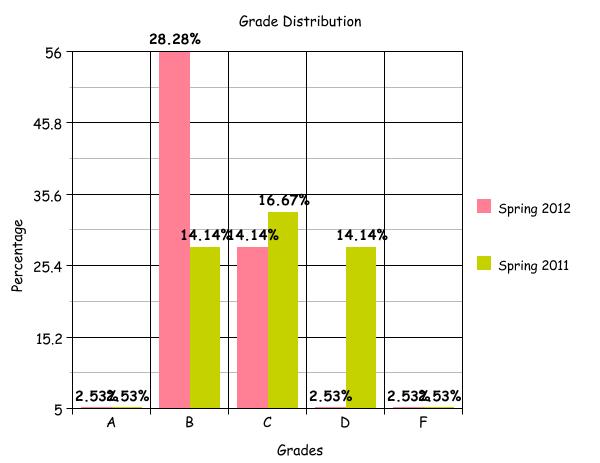
Why am I excited? There were more “Bs” and less “Ds” this semester than with the first exam for last spring’s course. I haven’t made a complete analysis yet-I’m waiting to finish grading the essay portion of the exam, but compared to last year, the numbers are up. Last spring, on the first exam, the grades ranged from 12-27/30; the median was 73.3 percent; and the average was 72.6 percent. This semester, on the objective portion of the test, the range was 11-18/20; the median was 80%; and the average was 77.5 percent. Look at this comparison of the grade distribution for spring 2012 and spring 2011:
Graph of First Exam Grade Distribution
These are promising initial results, although I need to do more research and analysis to determine the cause of this good result and whether it can be sustained.
This is what Lolu, one of the students said about the way Twitter was used in this class:
We’re now learning that regions cannot be associated with a singular function (i.e. the frontal cortex as “the place where personality occurs”). The brain is not a storage dump, and consciousness is not a place. Synapses are also far more complex than electrical circuits. Neither processing speed nor short term memory capacity are fixed, whereas RAM is.
In the above-referenced blog post, Megan Erickson reports on more current research that calls into question the idea of a compartmentalized brain.Erickson summarizes the points made by a cognitive neuroscience. The gist of the summary was that our brain is so complicated that there can be no analogy (yet) to a computer, in part because we are not aware of the distinct individual processes that if combined explain how the brain functions.
I am neither a scientist nor a doctor. But I had believed the theory that the brain is a machine similar to the computer; that certain areas of the brain perform certain functions and that the synapses were similar to electric circuits. At the same time, I thought it was not a complete picture of the brain–just as our bodies can adapt; sometimes when you lose hearing, your eyesight becomes clearer, I still thought the theory that the brain was divided into certain functioning parts made sense. And what about the idea of left brained and right brained folks? It all made sense, in a simplistic sort of way.
What was I thinking?
I can’t wait to have the discussion about whether Data is a sentient being!
I love new technology tools. I’m waiting for the first truly functional house-cleaning, grocery-story-shopping, laundry-washing and folding, meal-preparing robot á la the Jetsons’ Rosie, the robot maid. I prefer playing around with my computer, my iPad, my tablet and my iPhone instead of….working. And lucky for me, my day job permits me to play around with technology and work at the same time.
I was also moved by the video produced by Michael Wesch’s anthropology class that focused on students’ lack of engagement with teaching, with learning, and with the material.
The video highlighted issues that many of us (faculty) had ignored about students’ world. And I agreed with Wesch’s focus on creating technology-based and enhanced real-life projects to reach and engage students.
Now Wesch is re-thinking his focus. In Jeffrey Young’s recent interview of Wesch, summarized in the Chronicle Article article, “A Tech-Happy Professor Reboots After Hearing His Teaching Advice Isn’t Working,” Wesch noted that other professors had tried his suggestions on technology use and had informed him that the technology did not work. In the article, Young describes Wesch’s encounters with faculty who lecture and who make a connection with students in the lecture (and who therefore believe learning has occurred). Those faculty connect with students despite the decision to forgo technology. According to Young, Wesch’s key point was that with all technology-enhanced teaching techniques, the technique’s success ultimately depended on the intangible “bond between professor and student.” Wesch’s point was that although technology can engage students, the students’ connection with the faculty helped determine student success.
I agree, with reservations.
The article does not refer to the research that supports the position that if the students “connect” through lecture that the expected learning occurs. My own research (of one, as a student in college, 30 + years ago!) supports the idea, in part, that a dynamic lecturer can connect with students and encourage them to want to learn. My own research (same standard as before!) alsosupports that there were some “dynamic” lecturers who neither engaged me nor fostered my desire to learn. My desire to learn in those situations was internal: I wanted to maintain my high grades so I could know enough to get into the courses I really wanted! And frankly, if dynamic lectures are truly the only significant ways to impart knowledge, I have a heretical suggestion: hire actors/actresses, train them well to express enthusiasm and “connection” and let them teach the courses! If research supported that lectures are the best/only way to promote learning, then students would succeed at much higher rates than they do now. Learning is more complicated than listening to a lecture. And there are multiple ways for faculty to connect with students.
There are intangibles that promote a connection between faculty and students so that students learn. Some exist with lectures. Some exist in online classes when students, when prompted appropriately, engage in thought provoking discussions. Some exist in face-to-face small group discussions where faculty and students examine topics. Some exist when students meet with faculty outside of the classroom. Some exist when students participate in out of the classroom service-learning projects. Some exist when students are immersed in the topic through technology or through, for example, performance. The point is that as faculty we can choose, adapt test and research teaching methods to determine which works well for students and for the faculty. And if it promotes critical thinking, deeper inquiry or other noteworthy educational goals, then learning has occurred regardless of the technology.
That’s the real message!
So yes, Rosie would be a wonderful addition to my household! But if I had a house filled with young children (as opposed to my current household that includes one grandchild to whom I’ve introduced technology and who embraces it just as her grandmother does!) I would be sure to let those children know that Rosie’s there to make one aspect of life easier, but that Rosie is not there to substitute for every aspect of life. Rosie may clean, for example, but I would want my young children to know what it means to make things dirty, what dirt is, and why it could be harmful (or useful, depending on the discussion). In other words, the technology is a tool that can be used to broaden students learning and to appeal to, or reach students. It is not a substitute for the hard work of learning (and teaching).
Have you ever focused on something so much that time seemed to stand still? And when you finished, you looked up and a great deal of time had passed?That’s happened when I’ve had a good meditation session or when I’m reading or writing something that requires a great deal of thought.
“When you can focus all of your brain on one thing, that’s when you’re at your best…”You’re integrating all your brain. But it also consumes a huge amount of resources. You get tired. That’s really how the brain learns—when the brain is learning, it’s laying down new networks. The brain is changing when we focus. It takes a lot of energy, and when it’s depleted it isn’t able to manage the emotional brain. When your pre frontal cortex is depleted, your emotions rule all day”
In the Life’s Messy article, the author summarizes Moore’s approach by describing stress as a positive and strong emotion that is not always negative, but that can be used to help re-train the brain to think and to try to bring order and organization from chaos. Moore recommends that we use stress to ask ourselves questions that could lead to re-organization. She gives the example of question such as “‘is this an error message? Or is this something I really need to pay attention to?’” Moore continues by proposing that we can re-train our brains by building willpower, motivation and confidence.
So Test Anxiety s a Good Thing?
So what does that mean? As a teacher, certain situations create more stress for students than others. Tests, especially the traditional closed-book, closed notes tests, create a great deal of stress for students. So, is this author suggesting that those stressful test situations are good? Apparently, it is the body’s way of getting attention and to the extent that that attention can be properly focused (i.e. to prepare properly), then perhaps test anxiety isn’t all bad. The key is to assist test takers to focus that stress on productive study techniques.
Or does all that concentrating just wear us out (but that’s a good thing, because we do our best work when we focus….and experience stress)?!
This is a follow up of the first post on Twearning: Twitter + Learning. The first class report on the tweets submitted in and outside of class during the first two weeks of class was good. It highlighted key information and gave all students an opportunity to review the material. The group presented using Prezi and that was an unexpected bonus.
If it’s true that reviewing something again is useful for learning, then this is a step in the right direction. I look forward to what happens long term as we progress through the semester and tackle more difficult topics.
Prezi is a neat presentation tool that permits more 3-dimensional presentation of material. See sample below from my presentation to the Academy of Legal Studies in Business in August 2011 [Click on the title to this blog post to see the full Prezi presentation below-then click on the right arrow button]:
In the article, Do Students Have Copyright to their Own Notes, Erica Perez summarizes the arguments pro and con for students owning their class notes. The specific concern was that students were uploading the notes onto websites and, in some cases, purporting to sell them.
First, should students have a copyright in their own notes? Absolutely!
Students’ notes are copyrighted by the students and students should be able to do anything they want with them, including sell them (although California law makes that illegal) or post them on a website. After all, when students take notes, they’re adding their interpretations of what their instructors present in classes. This is true whether the students copy from a faculty-member provided outline or whether students create and outline the notes solely from lectures or other presentations. And notes memorialize what students heard, so they can use them to study, to study with others in the class and to help students who did not attend class.
So, why the fuss? Faculty believe that the notes students take during class are based on instructors’ intellectual property. That intellectual property is the faculty members’ in-class presentation of research (sometimes) or other information that the faculty members have developed over time and often at great effort and expense. But let’s examine that point more closely. Most faculty did not create this knowledge independently–they created it by “standing on the shoulders of giants” in their fields and building on those giants’ research and knowledge. Although the instructors present their “take” on the knowledge and the faculty’s presentation is thus copyrightable/copyrighted and valuable, that doesn’t mean that the students cannot copyright their “take” on the information. Each individual’s interpretation of the information has value-and copyright law permits that value to be protected.
This raises a larger issue, though, the issue of “knowledge” in general and the copyright law in particular. In education, we remain wedded to the notion that knowledge resides solely within the purview of the instructor. Think about it, though. According to Google, there are nearly 130 million books (and it plans to digitize all of them). As of August 2010, Google has digitized approximately 12 million. That does not include other works, such as peer-reviewed articles available in paper and electronic format. It’s impossible for any one faculty member to have mastery over any significant part of that. In fact, that’s the reason that teaching information and digital literacy is so important-it’s not only having some knowledge that’s important, it’s equally important to be able to find and critically evaluation the information that’s available everywhere.
Most of us in higher education teach behind closed doors. We enter the classroom and the teaching and learning that occurs behind that door is a secret between the teacher and the students in that course. When students finish that course, they are to emerge with greater knowledge than when they entered. And I hope that’s true. Appropriate assessment can help faculty determine whether that has occurred.
Yet access to information has changed and so, too, must faculty’s role. The recitation and Socratic method of questioning so popular during Socrates’ time was based on the idea that Socrates had “read all the books” and as he presented his oratory he questioned his students to ensure that they were “getting it,” partly because the students hadn’t “read all the books.” Now, students have access to the books and access to a wide variety of digital resources-credible and non-credible. As technology continues to improve, students will be able to use their cell phones to access far more resources than the faculty. Faculty’s role must change to one of assisting students evaluate and manage that information, in addition to passing on the key concepts of a discipline. This evolution involves disruptive, transformational change in the way faculty promote and assess learning.
And copyright law has its own problems in that it, as Lessig would say, stifles creativity. I agree. If we continue to restrict access to
information, that will, of necessity encourage underground versions of information or stifle creative versions of information.
So, should students own the copyright to their notes? Absolutely! Does that have an impact on education? Yes, as long as we continue to teach from behind closed doors. Should it have that significant an impact? Absolutely not! Let’s move past this discussion to work on institutional change in the way we teach.
It seems perfectly sensible and logical. As educators, we should take advantage of the research on how people learn and use it to guide our teaching. But we don’t! Instead, we stick with the tried and true (I did it this way, I learned this way and if students don’t get it, that’s their problem!) I’ve discussed this issue in other posts, for example, Is Higher Education Ready to Change, but it’s worth repeating.
Harvard recently held a one day symposium on the issue to try to encourage faculty to incorporate cognitive research findings into their teaching. This conference kicked off Harvard’s receipt of a $40-million dollar gift. The gift forms the basis of grants to faculty for Harvard’s Initiative on Learning and Teaching.
Other conference speakers noted that students are changing, and that, for example, students are not as curious as before. Dr. Mahzarin R. Banaj debunked the popular belief that teaching should be designed to fit diverse learning styles-e.g. kinesthetic or visual styles. Others noted the importance of quizzing and frequent writing.
So what does this mean? It means that Universities should encourage faculty to develop evidence-based teaching practices. It means that faculty workloads would have to be adjusted to permit time for faculty to implement and evaluate new methods of teaching. It means that Universities should assist faculty to assess the impact of these new methods of teaching. The University of Central Florida has a center devoted to helping faculty assess the impact of their teaching. I’m ready to try it!
Student engagement is one of the keys to improving student learning. This semester, students in the sports marketing law class are using twitter to tweet notes during class and to tweet notes while they are reading the textbook or other course-related reading. In addition, students are following the tweets of professional athletes to ultimately identify and discuss legal issues that can arise from the athletes’ use of Twitter. More to come.










 Ida's Blog