I am very excited! The results for the multiple choice-true false section of the first test were great! In this class, I am testing the use of Twitter as a social media supplement to the class. I explain how I’m using Twitter in this post. In sum, students must post tweets 4 times per week (once during each of two classes per week and two outside of class).
Why am I excited? There were more “Bs” and less “Ds” this semester than with the first exam for last spring’s course. I haven’t made a complete analysis yet-I’m waiting to finish grading the essay portion of the exam, but compared to last year, the numbers are up. Last spring, on the first exam, the grades ranged from 12-27/30; the median was 73.3 percent; and the average was 72.6 percent. This semester, on the objective portion of the test, the range was 11-18/20; the median was 80%; and the average was 77.5 percent. Look at this comparison of the grade distribution for spring 2012 and spring 2011:
Graph of First Exam Grade Distribution
These are promising initial results, although I need to do more research and analysis to determine the cause of this good result and whether it can be sustained.
This is what Lolu, one of the students said about the way Twitter was used in this class:
I love new technology tools. I’m waiting for the first truly functional house-cleaning, grocery-story-shopping, laundry-washing and folding, meal-preparing robot á la the Jetsons’ Rosie, the robot maid. I prefer playing around with my computer, my iPad, my tablet and my iPhone instead of….working. And lucky for me, my day job permits me to play around with technology and work at the same time.
I was also moved by the video produced by Michael Wesch’s anthropology class that focused on students’ lack of engagement with teaching, with learning, and with the material.
The video highlighted issues that many of us (faculty) had ignored about students’ world. And I agreed with Wesch’s focus on creating technology-based and enhanced real-life projects to reach and engage students.
Now Wesch is re-thinking his focus. In Jeffrey Young’s recent interview of Wesch, summarized in the Chronicle Article article, “A Tech-Happy Professor Reboots After Hearing His Teaching Advice Isn’t Working,” Wesch noted that other professors had tried his suggestions on technology use and had informed him that the technology did not work. In the article, Young describes Wesch’s encounters with faculty who lecture and who make a connection with students in the lecture (and who therefore believe learning has occurred). Those faculty connect with students despite the decision to forgo technology. According to Young, Wesch’s key point was that with all technology-enhanced teaching techniques, the technique’s success ultimately depended on the intangible “bond between professor and student.” Wesch’s point was that although technology can engage students, the students’ connection with the faculty helped determine student success.
I agree, with reservations.
The article does not refer to the research that supports the position that if the students “connect” through lecture that the expected learning occurs. My own research (of one, as a student in college, 30 + years ago!) supports the idea, in part, that a dynamic lecturer can connect with students and encourage them to want to learn. My own research (same standard as before!) alsosupports that there were some “dynamic” lecturers who neither engaged me nor fostered my desire to learn. My desire to learn in those situations was internal: I wanted to maintain my high grades so I could know enough to get into the courses I really wanted! And frankly, if dynamic lectures are truly the only significant ways to impart knowledge, I have a heretical suggestion: hire actors/actresses, train them well to express enthusiasm and “connection” and let them teach the courses! If research supported that lectures are the best/only way to promote learning, then students would succeed at much higher rates than they do now. Learning is more complicated than listening to a lecture. And there are multiple ways for faculty to connect with students.
There are intangibles that promote a connection between faculty and students so that students learn. Some exist with lectures. Some exist in online classes when students, when prompted appropriately, engage in thought provoking discussions. Some exist in face-to-face small group discussions where faculty and students examine topics. Some exist when students meet with faculty outside of the classroom. Some exist when students participate in out of the classroom service-learning projects. Some exist when students are immersed in the topic through technology or through, for example, performance. The point is that as faculty we can choose, adapt test and research teaching methods to determine which works well for students and for the faculty. And if it promotes critical thinking, deeper inquiry or other noteworthy educational goals, then learning has occurred regardless of the technology.
That’s the real message!
So yes, Rosie would be a wonderful addition to my household! But if I had a house filled with young children (as opposed to my current household that includes one grandchild to whom I’ve introduced technology and who embraces it just as her grandmother does!) I would be sure to let those children know that Rosie’s there to make one aspect of life easier, but that Rosie is not there to substitute for every aspect of life. Rosie may clean, for example, but I would want my young children to know what it means to make things dirty, what dirt is, and why it could be harmful (or useful, depending on the discussion). In other words, the technology is a tool that can be used to broaden students learning and to appeal to, or reach students. It is not a substitute for the hard work of learning (and teaching).
This is a follow up of the first post on Twearning: Twitter + Learning. The first class report on the tweets submitted in and outside of class during the first two weeks of class was good. It highlighted key information and gave all students an opportunity to review the material. The group presented using Prezi and that was an unexpected bonus.
If it’s true that reviewing something again is useful for learning, then this is a step in the right direction. I look forward to what happens long term as we progress through the semester and tackle more difficult topics.
Prezi is a neat presentation tool that permits more 3-dimensional presentation of material. See sample below from my presentation to the Academy of Legal Studies in Business in August 2011 [Click on the title to this blog post to see the full Prezi presentation below-then click on the right arrow button]:
Student engagement is one of the keys to improving student learning. This semester, students in the sports marketing law class are using twitter to tweet notes during class and to tweet notes while they are reading the textbook or other course-related reading. In addition, students are following the tweets of professional athletes to ultimately identify and discuss legal issues that can arise from the athletes’ use of Twitter. More to come.
Clickers have been touted as an active learning technique that engages students and improves learning. However, just as with any technique, there is a downside. According to the article author, the larger the class, the more likely it is that students will cheat using clickers. Students cheat by sending a representative to carry their clickers and record responses. And if used for homework, students consult with each other during the class to get homework answers.
Solutions:
Count clicker responses as a relatively small percentage of the overall grade (5% or less)
Have teaching assistants “patrol” the classes to search for those who have multiple clickers
Count the number of attendees and the number of clicker responses (difficult with mega-classes)
For every education innovation or technology, there’s a corresponding reaction by some to minimize effort required and thereby maximum the lack of learning. Use technology but be aware of that tension and take steps to address. I’ve previously discussed cheating in this blog.
I am attending the Western AAEEBL conference in Salt Lake City Utah on ePortfolios. Helen Barrett was the lunchtime speaker and she provided a great deal of information which I have compiled in tweets at the #11WAAEEBL hastag. [To find those, go to Twitter and type that hashtag in the search box.] Barrett discussed 3 points that I want to note here:
Label the eportfolio with an adjective so we know its purpose, e.g. learning eportfolio
Mobile technology is important for future technologies
Digital storytelling is more than entertainment; it’s also a method of learning
Those items have given me food for thought as I continue my journey to determine whether ePortfolios are solid assessment tool. I’ve discussed this a little bit in a previous post.
Why is it that in academia we do not routinely adopt “best practices” created by other institutions? Why is it that we prefer to reinvent the wheel?
Maybe it’s the fact that to earn a doctorate one had to research and write an innovative, new, previously un-researched aspect of one’s discipline. The mindset that permits one to succeed in that environment may also be a mindset that prevents one from merely adopting another’s practices. Maybe it’s also the fact that each institution believes that its students and environment are so unique that what works for one institution will not necessarily work for another.
It is the latter belief in each institution’s uniqueness, that is the topic discussed in Beating the ‘Not Invented Here’ article by Josh Fischman in the Chronicle’s Wired Campus. In the article, the author summarizes a panel presentation by stating “There are plenty of good ideas, the two said, but colleges are reluctant to adopt solutions that did not arise from their own campuses.”
One example of that on our campus is student evaluations. At the end of each semester, students complete evaluation forms for every course taught by adjunct and tenure track faculty. Each college in the University has a different evaluation form and many of the forms were developed by a group of faculty within each school. There are commercial instruments available composed of validated, reliable questions-yet faculty choose not to use them because, in part, our campus is so unique.
Student course evaluations can have an inordinate impact on faculty retention and promotion. This is true whether the course evaluations are composed of rigorously tested questions or not. And, this is true even though students may not be entirely honest about their answers to the questions. In my post Another A Word-Course Evaluations, I talk about a study in which one of its findings was that students lie in course evaluations. Even though that is probably true, and it is also true that faculty can (and may have an incentive to) manipulate course evaluations, faculty committees and administrators continue to place inordinate weight on those evaluations when making hiring, promotion and tenure decisions. The point here is that if course evaluations are to be used to make such decisions, those evaluations should be based on reliable, validated questions created by experts.
The point of the example is that universities should embrace best practices that have been successful and universities should focus upgrading the wheel rather than reinventing it. That would be more efficient, more effective and permit faculty to focus on improving teaching and learning.
The National Center for Academic Transformation (NCAT) urges institutions to develop low cost, effective methods to deliver course content and improve learning. Efficient uses of technology are integral to that process.
But what if the technology is a substitute for professors? That is one of the greatest fears of academics-that faculty will be replaced with professors in a box who do not “teach” and that instead serve as reviewers similar to instructors in correspondence courses.
In the article A Curricular Innovation, Reexamined, an Inside Higher Education special report on a for-credit set of courses organized by StraighterLine, the organization raised questions about the use of technology in teaching. According to the article, the courses are cheap (unlimited for $99 per month, $399/course, or 10 for $999) and are accepted for credit at some institutions. The report highlighted some positives-individual tutoring and the ability to self-test for improvement and some negatives–older course materials and significant numbers of errors.
I think that quality can be incorporated into online courses. The report reminds me that we need to be vigilant to be sure that online materials must be checked for rigor. The report also reminds me that face-to-face courses are seldom rigorously evaluated and should be subject to the similar oversight for quality.
Have you ever presented materials (PowerPoint slides, handouts, exams), that had errors? Have you ever said something in class that was wrong and later had to correct it? In a face-to-face class, the only people who know you made those errors are the students who saw the materials. Seldom do our peers review all our materials and note errors. In an online class, those items are memoralized electronically in the course and thus errors can be more easily identified. Since many faculty want to check online course materials more carefully, the errors become a basis for arguing that online education and materials are inferior.
So what does that mean for innovation? We must innovate and as faculty we should be integrally involved in oversight of face to face and online courses. We have to figure out the balance between academic freedom and evaluating quality, but some of the problems discovered in online courses are also equally evident upon review of face to face courses.
The Association for Information and Media Equipment has announced that it has sued UCLA because it allows students access to streaming video that UCLA has made available to its students. This lawsuit is the result of an ongoing battle between UCLA and this organization of whether UCLA’s decision to permit student access via streaming video is consistent with the fair use exception to the U.S. Copyright law.
It is ironic that this lawsuit was filed the week after I lead a discussion of Web 2.0 and Plagiarism at the DET/CHE conference last week. One of the discussants mentioned the dispute between UCLA and AIME and noted that AIME’s purpose (creating educational video for sale and use) was negated if educational institutions would be permitted to stream the video. Pricing models for video were traditionally based on how many copies of the video were purchased and if only one was purchased, then would not be profitable to make (and sell) the video.
This dispute is reminiscent of the issue faced by music manufacturers after digital music was available. After peer-to-peer sharing networks were created, music manufacturers could not longer force customers to purchase an entire album of music to obtain a song or two that they liked. iTunes and others recognized that there was a market in selling songs individually and as albums. Although the iTunes model did not solve all the problems of illegal downloads, it was certainly a practical alternative for those customers who wanted to obtain the music legally and did not want to purchase an entire album.
So perhaps the pricing model should change. In the article Who’s Right on Video Copyright, the author suggested that videos should be sold by the use (e.g. so that students pay each time they watch the streaming video). Another model might be to encourage institutions to collaborate to help pay for the video (through mini-grants, for example) and those institutions would have access to the streaming video. Another might be to commission institutions who have media majors to create professional videos and compensate students and others to create those videos. A combination of these and other approaches might result in educator access to videos and profits for the video producers. Reliance on the traditional pricing model when technology has changed the way institutions and individuals gain access to videos seems misplaced.
In the article Mapping the Terrain of Online Education, Kenneth Green summarizes the increase in online education. He notes the increase in the number of students taking online courses and ee notes that a significant number of schools require that faculty receive training. He also refers to a Higher Ed article that explains survey results that the significant obstacles to online learning are internal rather than external.
Fresno State is moving in the direction of increasing its offering of online courses. It’s an exciting trend, especially as the focus continues to be on the quality of the courses rather than merely adding online courses just to add them.
The struggle to evaluate the extent and quality of learning in the traditional environment is mirrored in that same struggle in the online environment. How do we know how much/whether students have learned? How do we measure that learning? Which tools work best for which students? Which instructors are more effective using which teaching methods? Where are the benefits of online learning? How are they to be measured? There are a host of questions and some research to answer the questions. A core question is how do we measure learning in any environment? If we can answer that question, that can help us determine the effectiveness of a variety of teaching methods.

 this class, I am testing the use of Twitter as a social media supplement to the class. I explain how I’m using Twitter in this post. In sum, students must post tweets 4 times per week (once during each of two classes per week and two outside of class).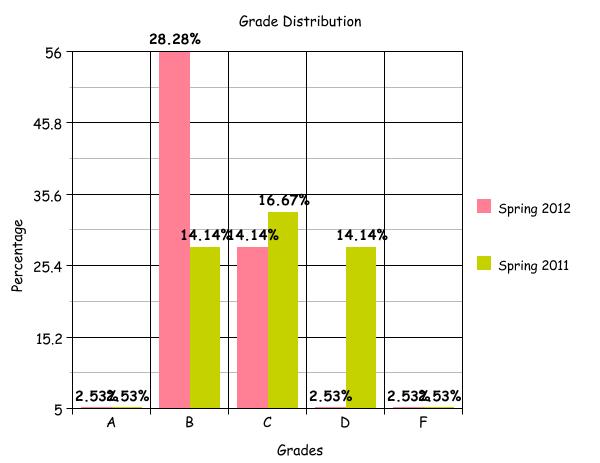


 Ida's Blog