
Ditch the Technology-Just Teach!

I love new technology tools. I’m waiting for the first truly functional house-cleaning, grocery-story-shopping, laundry-washing and folding, meal-preparing robot á la the Jetsons’ Rosie, the robot maid. I prefer playing around with my computer, my iPad, my tablet and my iPhone instead of….working. And lucky for me, my day job permits me to play around with technology and work at the same time.

I was also moved by the video produced by Michael Wesch’s anthropology class that focused on students’ lack of engagement with teaching, with learning, and with the material.

The video highlighted issues that many of us (faculty) had ignored about students’ world. And I agreed with Wesch’s focus on creating technology-based and enhanced real-life projects to reach and engage students.

Now Wesch is re-thinking his focus. In Jeffrey Young’s recent interview of Wesch, summarized in the Chronicle Article article, “A Tech-Happy Professor Reboots After Hearing His Teaching Advice Isn’t Working,” Wesch noted that other professors had tried his suggestions on technology use and had informed him that the technology did not work. In the article, Young describes Wesch’s encounters with faculty who lecture and who make a connection with students in the lecture (and who therefore believe learning has occurred). Those faculty connect with students despite the decision to forgo technology. According to  Young, Wesch’s key point was that with all technology-enhanced teaching techniques, the technique’s success ultimately depended on the intangible “bond between professor and student.” Wesch’s point was that although technology can engage students, the students’ connection with the faculty helped determine student success.

I agree, with reservations.

The article does not refer to the research that supports the position that if the students “connect” through lecture that the expected learning occurs. My own research (of one, as a student in college, 30 + years ago!) supports the idea, in part, that a dynamic lecturer can connect with students and encourage them to want to learn. My own research (same standard as before!) also supports that there were some “dynamic” lecturers who neither engaged me nor fostered my desire to learn. My desire to learn in those situations was internal: I wanted to maintain my high grades so I could know enough to get into the courses I really wanted! And frankly, if dynamic lectures are truly the only significant ways to impart knowledge, I have a heretical suggestion: hire actors/actresses, train them well to express enthusiasm and “connection” and let them teach the courses! If research supported that lectures are the best/only way to promote learning, then students would succeed at much higher rates than they do now. Learning is more complicated than listening to a lecture. And there are multiple ways for faculty to connect with students.

There are intangibles that promote a connection between faculty and students so that students learn. Some exist with lectures. Some exist in online classes when TN_crca_dogs_friendsstudents, when prompted appropriately, engage in thought provoking discussions. Some exist in face-to-face small group discussions where faculty and students examine topics. Some exist when students meet with faculty outside of the classroom. Some exist when students participate in out of the classroom service-learning projects. Some exist when students are immersed in the topic through technology or through, for example, performance. The point is that as faculty we can choose, adapt test and research teaching methods to determine which works well for students and for the faculty. And if it promotes critical thinking, deeper inquiry or other noteworthy educational goals, then learning has occurred regardless of the technology.

That’s the real message!

So yes, Rosie would be a wonderful addition to my household! But if I had a house filled with young children (as opposed to my current household that includes one grandchild to whom I’ve introduced technology and who embraces it just as her grandmother does!) I would be sure to let those children know that Rosie’s there to Jetsons_TVfamilymake one aspect of life easier, but that Rosie is not there to substitute for every aspect of life. Rosie may clean, for example, but I would want my young children to know what it means to make things dirty, what dirt is, and why it could be harmful (or useful, depending on the discussion). In other words, the technology is a tool that can be used to broaden students learning and to appeal to, or reach students. It is not a substitute for the hard work of learning (and teaching).
Thinking About Thinking..I’m Tired Already

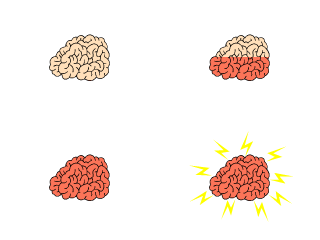
Have you ever focused on something so much that time seemed to stand still? And when you finished, you looked up and a great deal of time had passed?That’s happened when I’ve had a good meditation session or when I’m reading or writing something that requires a great deal of thought.

According to Margaret Moore, (as quoted in this article: Life’s Messy. Train Your Brain to Adapt) co-director of the Institute of Coaching,

“When you can focus all of your brain on one thing, that’s when you’re at your best…”You’re integrating all your brain. But it also consumes a huge amount of resources. You get tired. That’s really how the brain learns—when the brain is learning, it’s laying down new networks. The brain is changing when we focus. It takes a lot of energy, and when it’s depleted it isn’t able to manage the emotional brain. When your pre frontal cortex is depleted, your emotions rule all day”

In the Life’s Messy article, the author summarizes Moore’s approach by describing stress as a positive and strong emotion that is not always negative, but that can be used to help re-train the brain toBrain think and to try to bring order and organization from chaos. Moore recommends that we use stress to ask ourselves questions that could lead to re-organization. She gives the example of question such as “‘is this an error message? Or is this something I really need to pay attention to?’” Moore continues by proposing that we can re-train our brains by building willpower, motivation and confidence.

So Test Anxiety s a Good Thing?

So what does that mean? As a teacher, certain situations create more stress for students than others. Tests, especially the traditional closed-book, closed notes tests, create a great deal of stress for students. So, is this author suggesting that those stressful test situations are good? Apparently, it is the body’s way of getting attention and to the extent that that attention can be properly focused (i.e. to prepare properly), then perhaps test anxiety isn’t all bad. The key is to assist test takers to focus that stress on productive study techniques.

Or does all that concentrating just wear us out (but that’s a good thing, because we do our best work when we focus….and experience stress)?!

Still Adrift in Education

In his essay,’ Academically Adrift’: the News Gets Worse and Worse, Kevin Carey, explains that there is more information that not only do college students fail to learn in college, but also that students who perform lower on the CLA (Collegiate Learning Assessment) also fail to find financial security after graduation.

In an earlier post, I discussed some of the conclusions I reached from the sections of the book which I had read. Those conclusions were:

  • There is an inverse relationship between the number of faculty publications and a faculty orientation toward students.
  • The higher students’ grades in the course, the more positive the student evaluations.
  • Grade inflation probably exists.

In a later post, I discussed critical thinking as a concern: that students don’t “enjoy” the challenge of traditional problem solving the way I (and other faculty) do and that has an impact on whether students learn. If students do not see tackling and solving problems as a challenge (and we as educators should do as much as we can to make problem-solving interesting), then there will be a significant impact on student learning.

A Not So Radical Transformation in a Core Business Course

In the introductory business law course that is required for all business majors, all the faculty teaching the course agreed to make substantial changes in the way the course was taught in order to acknowledge and address perceived efficiencies: students lack of college-level ability to read, college-level ability to write and need to improve critical thinking. Students complained a great deal about the additional work.

Assessing and Working to Improve Reading Skills

Although my own experience with students confirms that it would help for them to have more practice reading and writing, the students did not agree. When asked whether My Reading Lab (a publisher-created product) helped them, students said no:

WhetherMyReadingLabHelped-BA18F11

Note that this response is only the student’s perceptions. We have not yet completed an analysis to determine whether those who performed better on My Reading Lab performed better on the tests or in the course. We will work on analyzing that data later. This also does not included longitudinal data, i.e. would students, upon reflection, decide that they had learned more than they thought by the additional practice reading. However, what this data does show is that students did not embrace the additional reading practice and testing requirement.

Reading the Textbook

Student preparation for class is a concern. Many students do not read before attending class; they attended class then read after class.  In addition, students did not study. As part of the course redesign, we required quizzes prior to students attending class. Students (74.2%) agreed that the quizzes helped them keep up with the reading.  Even though the students said the quizzes helped them keep up with the reading, many still didn’t read everything. The following graph lists the students responses about whether they had read the textbook (this is at the end of the semester):

Percentageofreadingscompleted-BA18F11

Note that 40/202 or 19.8% read 90% or more of the readings and 80/202 or 39.6% read 80-89% of the readings. That means that nearly 60% of the class read 80% or more of the readings. These are the results obtained after faculty required that students read and take a quiz on the material before attending class. Thus, students were more motivated to keep up with the reading. How would these results differ if the students had not been required to take a quiz before attending class?

Studying

Student preparation and studying. The following graph includes information on the hours that students studied.

TimespentstudyingBA18F11

According to these self-reports, 21.2% of students studied between 1 and 3 hours per week, 27.7% of students studied between 3 and 5 hours per week, and 21.7% of students studied between 5 and 7 hours per week.  Students should have studied nearly 8 hours per week (2 hours per week outside class for each hour of class-this was a 4 unit course). In Chapter 4 of Academically Adrift, the authors note that students report spending 12 hours per week on their courses outside of class.  According to figure 4.2 of the book, in a 7 day week, students spent approximately 7% of their time studying.

Conclusions so far

The educational process requires that the faculty and the student participate, and if the students have not completed their share, then education and learning wouldn’t necessarily take place. I don’t know how this data compares to other studies on student reading, but it is challenging to help learning if both parties are not fully invested. Students have a variety of reasons for that lack of involvement, but if the investment in education is relatively small, then improvement in learning will be small.

In addition, this past semester, my student course evaluations were much lower (this was also partly due to a change in the institution’s survey evaluation instrument). Because I am tenured, I do not face losing my job over the changes in my student evaluations (although adjunct faculty face a different reality when it comes to being rehired). However, adjunct faculty depend on good student evaluations in order to keep their jobs. If that is the case, adding rigor to a class could cost that faculty member his or her job.

Twearning-Update on Learning

This is a follow up of the first post on Twearning: Twitter + Learning. The first class report on the tweets submitted in and outside of class during the first two weeks of class was good. It highlighted key information and gave all students an opportunity to review the material. The group presented using Prezi and that was an unexpected bonus.

If it’s true that reviewing something again is useful for learning, then this is a step in the right direction. I look forward to what happens long term as we progress through the semester and tackle more difficult topics.

Prezi is a neat presentation tool that permits more 3-dimensional presentation of material. See sample below from my presentation to the Academy of Legal Studies in Business in August 2011 [Click on the title to this blog post to see the full Prezi presentation below-then click on the right arrow button]:

Copyright Law + Education = Strange Bedfellows

In the article, Do Students Have Copyright to their Own Notes, Erica Perez summarizes the arguments pro and con for students owning their class notes. The specific concern was that students were uploading the notes onto websites and, in some cases, purporting to sell them.

First, should students have a copyright in their own notes?  Absolutely!

Students’ notes are copyrighted by the students and students should be able to do anything they want with them, including sell them (although California law makes that illegal) or post them on a website. After all, when students take notes, they’re adding their interpretations of what their instructors present in classes. This is true whether the students copy from a faculty-member provided outline or whether students create and outline the notes solely from lectures or other presentations. And notes memorialize what students heard, so they can use them to study, to study with others in the class and to help students who did not attend class.

So, why the fuss? Faculty believe that the notes students take during class are based on instructors’ intellectual property. That intellectual property is the faculty members’ in-class presentation of research (sometimes) or other information  that the faculty members have developed over time and often at great effort and expense. But let’s examine that point more closely.  Most faculty giants feetdid not create this knowledge independently–they created it by “standing on the shoulders of giants” in their fields and building on those giants’ research and knowledge. Although the instructors present their “take” on the knowledge and the faculty’s presentation is thus copyrightable/copyrighted and valuable, that doesn’t mean that the students cannot copyright their “take” on the information. Each individual’s interpretation of the information has value-and copyright law permits that value to be protected.

This raises a larger issue, though, the issue of “knowledge” in general and the copyright law in particular. In education, we remain wedded to the notion that knowledge resides solely within the purview of the instructor. Think about it, though. According to Google, there are nearly 130 million books (and it plans to digitize all of them). As of August 2010, Google has digitized approximately 12 million.  That does not include other works, such as peer-reviewed articles available in paper and electronic format. It’s impossible for any one faculty member to have mastery over any significant part of that. In fact, that’s the reason that teaching information and digital literacy is so important-it’s not only having some knowledge that’s important, it’s equally important to be able to find and critically evaluation the information that’s available everywhere.

Most of us in higher education teach behind closed doors. We enter the classroom and the teaching and leaRuins of Lamanai-doorrning that occurs behind that door is a secret between the teacher and the students in that course. When students finish that course, they are to emerge with greater knowledge than when they entered. And I hope that’s true. Appropriate assessment can help faculty determine whether that has occurred.

Yet access to information has changed and so, too, must faculty’s role. The recitation and Socratic method of questioning so popular during Socrates’ time was based on the idea that Socrates had “read all the books” and as he presented his oratory he questioned his students to ensure that they were “getting it,” partly because the students hadn’t “read all the books.” Now, students have access to the books and access to a wide variety of digital resources-credible and non-credible. As technology continues to improve, students will be able to use their cell phones to access far more resources than the faculty. Faculty’s role must change to one of assisting students evaluate and manage that information, in addition to passing on the key concepts of a discipline. This evolution involves disruptive, transformational change in the way faculty promote and assess learning.

And copyright law has its own problems in that it, as Lessig would say, stifles creativity. I agree. If we continue to restrict access to

information, that will, of necessity encourage underground versions of information or stifle creative versions of information.

So, should students own the copyright to their notes? Absolutely! Does that have an impact on education? Yes, as long as we continue to teach from behind closed doors.  Should it have that significant an impact? Absolutely not! Let’s move past this discussion to work on institutional change in the way we teach.

Twearning: Tweeting and Learning

Student engagement is one of the keys to improving student learning. This semester, students in the sports marketing law class are using twitter to tweet notes during class and to tweet notes while they are reading the textbook or other course-related reading. In addition, students are following the tweets of professional athletes to ultimately identify and discuss legal issues that can arise from the athletes’ use of Twitter. More to come.

MOOC

I love acronyms and this posts starts with a new one for me? MOOC is Massive Open Online Course.  I’m interested in finding out about this different way of teaching and presenting course content. It’s a little bit overwhelming, because it is not “structured” the

Scuba Diving Clipart
scuba diver

way I structure a class. For example, I’m entering during week 6-so there are previous weeks’ work that I haven’t looked at or completed. That is disconcerting for someone my friends characterize as somewhat structured and a workaholic.

So this post is the first of many I may post about MOOC and how/whether I’ve learned, The topic of this course is online learning (in a very broad sense) and this week’s topic is about OER-Open Educational Resources. So, I’m diving in….

What’s New is Old Again-More High-Tech Cheating

In the Chronicle article With Cheating Only a Click Away, Professors Reduce the Incentive, the author discusses student cheating in the classroom using student response systems or Clickers.

Clickers have been touted as an active learning technique that engages students and improves learning. However, just as with any technique, there is a downside. According to the article author, the larger the class, the more likely it is that students will cheat using clickers. Students cheat by sending a representative to carry their clickers and record responses. And if used for homework, students consult with each other during the class to get homework answers.

Solutions:

  • Count clicker responses as a relatively small percentage of the overall grade (5% or less)
  • Have teaching assistants “patrol” the classes to search for those who have multiple clickers
  • Count the number of attendees and the number of clicker responses (difficult with mega-classes)

For every education innovation or technology, there’s a corresponding reaction by some to minimize effort required and thereby maximum the lack of learning. Use technology but be aware of that tension and take steps to address. I’ve previously discussed cheating in this blog.

Improving Critical Thinking in Higher Education-Possibly

In Chapter 2 of Academically Adrift,  authors note that improving critical thinking is a skill that many university’s tout as one of their leading goals. Yet, according to the study, the improvement in critical thinking during the first two years of school is minimal at best—according to the authors, the improvement is statistically not above zero. The book authors state

An astounding proportion of students are progressing through higher education today without measurable gains  [emphasis added] in general skills as assessed by the CLA. While they may be acquiring subject specific knowledge or greater self-awareness on their journeys through college, many students are not improving their skills in critical thinking, complex reasoning, and writing.” (ch 2-reading on Kindle so don’t have page #)

How can that be? Institutions require that students take a package of courses and one key goal is to improve critical thinking. How is it that institutions can miss the mark by so much? Similarly GE courses have as one of their goals requiring students to write a minimum number of words in a course. Why is it that students cannot write (well) after their first few semesters in college?

I have a couple of thoughts (I still haven’t finished the book to find the authors’ suggestions). One is that faculty have not been taught how to teach critical thinking. Most of us teach the substantive content in our disciplines and teach primarily in the way that we had been taught. We presume that if we learned that way, then students can learn that way.

I enjoy critical thinking questions and challenges, yet I am not certain that I do a good job teaching students how to think critically. (And we don’t’ always agree what that means.) I try thinking, musing girl silhouetteto model how we think in the discipline through the way I solve problems, but I don’t know whether I’m helping students learn how to do it or not.

Critical thinking is a skill and habit of mind that must be practiced. At the same time, one must have an interest in it. If I am giving a complex problem, case scenario or reading, I dive in. I presume that I will be able to read through it and analyze it enough so that I can understand it. I see it as a challenge to try to understand it.

Many of my students do not approach tough material or a complex scenario with the same gusto. They seem to just want  me to tell them the answer and they are uncomfortable with the idea that there could be multiple ways of approaching the issue and multiple solutions depending on one’s interpretation of the scenario. They are not comfortable with the idea that I want to know how they arrived at the solution—they just want to know whether their solution is the “correct” solution.

So far, the reading implicitly presents an argument that these initial courses should be taught by full time-tenured faculty who have had guidance in learning how to teach someone to develop critical thinking skills. On most campuses, however, the faculty who tech the GE courses are part time or adjunct faculty and those faculty may be excluded from opportunities to learn how to teach critical thinking more effectively.

My theory on lack of writing ability is based on my concerns with student plagiarism. I will not repeat here what I explained in an earlier post.