
Using Research on Learning to Guide Teaching: Huh?!

It seems perfectly sensible and logical. As educators, we should take advantage of the research on how people learn and use it to guide our teaching. But we don’t! Instead, we stick with the tried and true (I did it this way, I learned this way and if students don’t get it, that’s their problem!) I’ve discussed this issue in other posts, for example, Is Higher Education Ready to Change, but it’s worth repeating.

Harvard recently held a one day symposium on the issue to try to encourage faculty to incorporate cognitive research findings into their teaching. This conference kicked off Harvard’s receipt of a $40-million dollar gift. The gift forms the basis of grants to faculty for Harvard’s Initiative on Learning and Teaching.

In a Chronicle article, Harvard Seeks to Jolt University Teaching, Dan Barrett summarizes explanations of the purposes for the symposium and workshop. Barrett quotes Dr. Weiman, a Nobel prize winning physicist, who has conducted research on science education and how students learn, and who explained that faculty often teach by “habits and hunches.” This is partially because most faculty are content experts and not pedagogy experts.

Other conference speakers noted that students are changing, and that, for example, students are not as curious as before.  Dr. Mahzarin R. Banaj debunked the popular belief that teaching should be designed to fit diverse learning styles-e.g. kinesthetic or visual styles. Others noted the importance of quizzing and frequent writing.

So what dDivingoes this mean? It means that Universities should encourage faculty to develop evidence-based teaching practices. It means that faculty workloads would have to be adjusted to permit time for faculty to implement and evaluate new methods of teaching. It means that Universities should assist faculty to assess the impact of these new methods of teaching. The University of Central Florida has a center devoted to helping faculty assess the impact of their teaching.  I’m ready to try it!
Critical Thinking in the Legal Profession

In the article 12 More Law Schools Face Lawsuits Over Job Placement Claims, the article’s author, Katherine Mangan, reports on the increasing number of law schools that have been sued for overstating the job prospects of their graduates. The articles lists the law schools that are the defendants in this latest round of lawsuits. The law school defendants include for profit and other law schools, including, for example, DePaul University College of Law and Hofstra Law School.

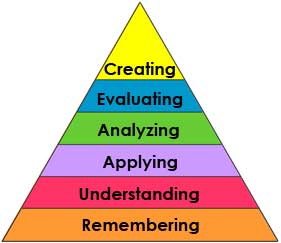
Where does critical thinking fit into the law school graduates’ plans? The lawsuits are disturbing because critical thinking seems to be in short Bloom's Taxonomysupply. No job placement statistics are guarantees. Job placement statistics provide information on the employment of past graduates-not guarantees that current graduates will find jobs. Critical thinking requires, among other things, that people analyze and evaluate information (see the revised Bloom’s taxonomy as pictured in this post) based on reflection, observation, evidence and reasoning. These are, I would hope, hallmarks of legal analysis and are reasonable expectations for those who have up to 7 years of post-secondary education. It’s disheartening to think that law school graduates have not developed those skills as well as I’d like to think.

Or maybe this is evidence that law schools will do anything, even attempt to mislead, in order to make money through recruiting graduates (and future donors).

ePortfolios for Assessment

I am attending the Western AAEEBL conference in Salt Lake City Utah on ePortfolios. Helen Barrett was the lunchtime speaker and she provided a great deal of information which I have compiled in tweets at the #11WAAEEBL hastag. [To find those, go to Twitter and type that hashtag in the search box.] Barrett discussed 3  points that I want to note here:

  1. Label the eportfolio with an adjective so we know its purpose, e.g. learning eportfolio
  2. Mobile technology is important for future technologies
  3. Digital storytelling is more than entertainment; it’s also a method of learning

Those items have given me food for thought as I continue my journey to determine whether ePortfolios are solid assessment tool. I’ve discussed this a little bit in a previous post.

Students Fail Because Colleges Fail

The Spring 2011 semester begins tomorrow, Wednesday, January 19. As I review my course syllabi one more time and ponder the weights to assign various assignments, I looked at today’s issue of the Chronicle-Faculty and read a blog post titled: New Book Lays Failure to Learn on Colleges’ Doorstep by David Glenn.

In that post, Glenn summarizes the findings in the recently released book, Academically Adrift: Limited Learning on College Campuses (University of Chicago Press). The book presents evidence, based on student scores on the Collegiate Learning Assessment, that faculty do not demand enough of students and thus students are ill-prepared by the time they graduate. One of the more disturbing, but not surprising conclusions include students self-report that they study 12 hours per week (the Carnegie study recommends that students study 2 hours for every hour in class, which is a minimum of 24 hours per week for a 12 unit semester load).

That conclusion matches what I’ve found when I’ve spoken with students, especially those who are struggling. Many do not know how many hours per week to study andBooks even more surprising, many do not know HOW to study.

During the past few semesters, I have included in the course syllabi of the undergraduate courses a recommendation that students study a certain number of hours per week and tips on how to study.  Another recent change has been to spend time discussing how to take tests-as faculty we assume that students know how to prepare for and have developed strategies to take tests. Many have not.

The book’s basis, results from the Collegiate Learning Assessment, does have the limitations that are noted in the article. However, one result should be that colleges should create a required course at the beginning of a students’ career that focuses on preparation for college-so that students know what is expected and thus can be better prepared. Another result is that faculty should not be afraid to challenge students and expect that they can do the work. Although that increases faculty workload and effort, it is necessary in order to graduate students who are truly prepared.

Does Learning to Read affect Learning to…..

In an intriguing blog post titled Wired to Read, that summarizes scientific research relating to the brain function and literacy, Peter Wood notes that the scientific research has revealed intriguing evidence that individuals ability to read comes at the cost of other brain functions. According to Wood, the research, based on a comparison of the brains of individuals who learned to read as children, as adults and not at all,  revealed differences in brain function among them. Wood, an anthropologist, posits that this means that some brain functions are sacrificed so that others can work better.

I’m not a scientist, so I cannot speak directly to the validity of the view, but I can use anecdotes from my own life as examples that confirm Wood’s unconfirmed speculation. I love to read and read a lot. My husband doesn’t. My husband and I both love music.  However, my husband’s musical skill and talent; his ability to hear music and replicate that music with his voice and/or with musical instruments is  far surpasses mine.

My own experience also supports Wood’s hypothesis that other skills may be weaker because of the emphasis on, for example, literacy. I am one of the most unobservant people my husband has ever encountered. We’ll walk or drive somewhere and I will be completely oblivious to something that my husband sees as so obvious. I tell him I’m the typical “absent minded professor” but he is unconvinced-he can’t understand why I can’t see something that is so obvious [to him]. And he says, on occasion, “I don’t understand how you can study law, but you can’t see ….[something that is in front of my face]. I laugh, because I don’t understand it either. Now, though I can tell him that it’s because my brain is wired differently.

What implication does that have for teaching and learning? I don’t know yet; I haven’t thought about it sufficiently. It does confirm that application of  Universal Design for Learning principles is a useful way to develop learning activities.

The “A” word–Assessment

Measuring student learning is one of instructor’s most difficult tasks. Assessment is also a difficult task for institutions.

In the article Measuring Student Learning, Many Tools, David Glenn, discusses the issue as an institutional issue and points out that a group of institutions have combined to study different methods of assessment. The group, headed by Charles Blaich, director of Wabash College’s Center of Inquiry in the Liberal Arts, seeks to collect data to determine effectiveness. Cr. Blaich encourages universities to use a variety of tools, as appropriate for the school, to collect data. He also encourages universities to use data they already collect, when possible.

I’ve used a variety of assessment methods in my classes: exams, scoring rubrics, ePortfolios using Mahara (an open source program) and now possibly Taskstream and  computer based testing (such as Criterion, a writing program). I have tried mind mapping, graphic organizers, research papers, short papers, multiple quizzes, take home exams, and oral presentations.

The tension is palpable. I can measure whether someone has memorized the content most easily through a test. I can measure critical thinking and ability to apply through a test. However, does that demonstrate learning or deep learning?  How does one measure learning (see this website, Approaches to Study: Deep and Surface, for more on the concept of deep learning) ?  Measure critical thinking? Measure successful integration of information learned with information previously learned?

So, I muddle along, measuring learning based on how my learning was measured (primarily through multiple-choice, true-false, essay, standardized, nationwide, validated tests-depending on when and what) and I add in what I learn from attending conferences, listening to experts and applying what I’ve learned to my classes in an effort to truly encourage and measure learning. Is it successful? It depends on who you ask.

That’s enough for this post; next post I’ll briefly discuss my foray into ePortfolios, my current preferred assessment method when I have adequate time to process the student information.

As you can see,  I will continue to struggle with the “A” word!

Online Learning Trends

In the article Mapping the Terrain of Online Education, Kenneth Green summarizes the increase in online education.  He notes the increase in the number of students taking online courses and ee notes that a significant number of schools require that faculty receive training. He also refers to a Higher Ed article that explains survey results that the significant obstacles to online learning are internal rather than external.

Fresno State is moving in the direction of increasing its offering of online courses. It’s an exciting trend, especially as the focus continues to be on the quality of the courses rather than merely adding online courses just to add them.

The struggle to evaluate the extent and quality of learning in the traditional environment is mirrored in that same struggle in the online environment. How do we know how much/whether students have learned? How do we measure that learning? Which tools work best for which students? Which instructors are more effective using which teaching methods? Where are the benefits of online learning? How are they to be measured? There are a host of questions and some research to answer the questions.  A core question is how do we measure learning in any environment? If we can answer that question, that can help us determine the effectiveness of a variety of teaching methods.

Teaching Backwards

I’m attending the Educause conference in Anaheim and listening to Gershenfield who taught a class called “How to Make (Almost) Anything” in which he asked students to come to class a build something. Student started the class with varying amounts of technical skill. He said the best time to get someone to “teach” something is when they first learn it. So, students who learned something that others’ needed to know would teach it over and over again, excitedly, because they were excited about what they had learned. At the end of the course, students had built projects.

What’s interesting about the conversation is the students learned as they needed-they didn’t start with a foundation of knowledge. Yet, they learned what they needed, and he used that methodology in places throughout the world. He asked the question whether MIT was obsolete. His answer: Not yet. Is that a question we should ask in education? And what can we do about it?

More information: Article How to Make (Almost) Anything (http://www.boston.com/news/globe/ideas/articles/2005/01/30/how_to_make_almost_anything/)

Sample class with the Fab Lab (http://fab.cba.mit.edu/classes/MIT/863.08/)

Learning (and Teaching) in the 21st Century

I belong to a reading group on campus that is reading Christopher Hedge’s Empire of Illusion (http://www.amazon.com/Empire-Illusion-Literacy-Triumph-Spectacle/dp/1568584377).

Thursday’s discussion focused in part on the differences in learning abilities now and what constitutes literacy. We discussed the public’s attendance at the Lincoln-Douglas debates to demonstrate the public’s literacy in the mid 1860s. That compared unfavorably with the nature and intellectual challenge of current political debates.  One participant in the discussion noted that the Lincoln-Douglas debates are difficult to read and understand now and this participant considers himself well-educated.

That analysis was interesting. My only comment was to wonder what percentage of people actually attended the debates and we didn’t have the answer. However, on reflection, I have another theory about it. What if the reason the debates were well attended was because that was the way most information was communicated? What if so much information was communicated orally that people who were literate were those who learned best by listening and analysis. If you consider Socrates’ oral tradition and his methods of challenging students to complicated verbal exchanges, it would make sense that those who learned best would be those who learn from listening.

To continue with that thought, what if in the 20th century, those who learn best are those who learn through reading? Those who became professors learned much through poring through books, making connections from that reading and flourished in that system. The oral lectures supplemented that learning, but perhaps we learn best from reading.

Now, we are teaching a generation of students who seem to focus best on “sound bytes” and quick flashes of visual information. Video games manage to attract individuals’ attention to “learn” how to master a game. And many individuals are motivated to follow through on video games enough to analyze a complicated game and develop a strategy to accomplish the goal.

So what does that mean for educators? As educators do we need to change how we change? How do we do that?  How do we get learners to maintain their curiosity about how life works? How to we get learners to develop that curiosity into a curiosity about multiple topics? How do we get learners to become as curious about learning as (many) are about videogames, social media sites and celebrities? That is our challenge.