Digital Information Everywhere: But it Doesn’t Change How We Educate Learners! Should it?!

directions_signInformation is everywhere and we should help students learn how to access and evaluate it. Education isn’t about going to school to get the information. Learning occurs with experiential activities, developing student activities and embracing failure as a way to learn.

I learned some concepts best when I answered them wrong on a test and got feedback quickly enough so that I could clearly follow where I went wrong. If we’re going to improve learning, as the video author states, we must refocus on how we encourage learning. Educators and institutions must re-evaluate the role of tests in promoting student learning and promoting cognition. Tests are not always the best way to foster improved learning. I believe tests are one tool, but there are many other tools to encourage authentic learning.

Because information is everywhere, we must also provide learners with the tools to evaluate information. The ALA defines information literacy as

“a set of abilities requiring individuals to “recognize when information is needed and have the ability to locate, evaluate, and use effectively the needed information.”

So students must know more than the textbook or teacher as the source of information, but instead must be able to read any source and conduct an target_and_arrow_missedanalysis of the credibility of the content. Institutions must develop methods to encourage the pedagogy of authenticity and of failure in order to learn. I’ve discussed the benefits of failure to improve learning in this post. I’ve discussed the need to teach information literacy in this post.

I’d love to implement and assess some version of this. That’s my next project, possibly, after I finish the Twitter and ePortfolio activities.

Twearning-First Exam Results Updated

I’m using Twitter in my class this semester. This class is composed of 18 students taking a required course in the Ethical and Regulatory Environment of Sports Marketing. Students range from second semester juniors to graduating seniors. Students must use Twitter to post tweets during class, post two tweets about course content (textbook readings or current events) outside class and prepare group reports summarizing the weekly tweets and present those summaries in class. This means, that during the class, students have laptops, smart phones and other electronic devices open during class.

I haven’t analyzed the data on the number of tweets per week, but my estimate is an average of nearly 50 tweets total each week (some students forget). I’ve found that the weekly summaries are good reinforcements and these summarizes also give me the opportunity to correct any misconceptions that arise from the tweets.

In the earlier post, I briefly compared the exam results between the Spring 2011 and Spring 2012 courses.  I had only the results of the objective portion of the exam, so it was a preliminary comparison.

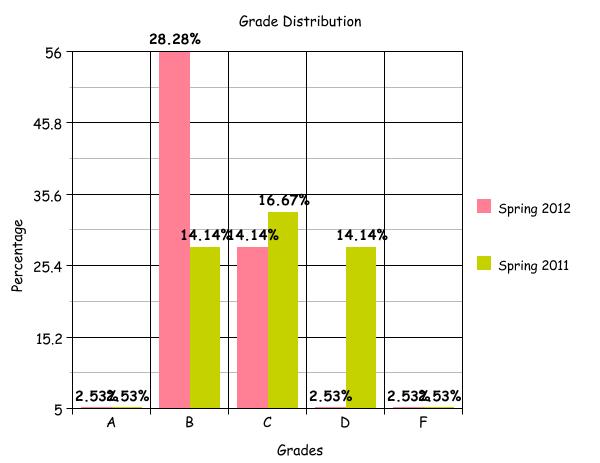
After completing the full exam, I’m now comparing the results this semester to the results last spring for this course. The following is the chart comparing the grade distribution.

Online Graphing

The results remain positive.

Grade distribution

There was a larger number of As and Bs in the Spring 2012 course (10/18 or 56%) compared to the Spring 2011 course (5/18 or 23%).  Interestingly, the number of Ds and Fs remained the same. The shift in grades was in the number of Cs: down from 33.3% in Spring 2011 to 16.5% in Spring 2012. There was a greater percentage of As in the Spring 2012 class (an increase of 400%).

Interpretation of results

These are small classes so although these results are promising, this doesn’t mean they can be translated to larger courses.

It appears that the use of Twitter in this way fostered student active engagement (I conducted a pre-survey and I’ll conduct a post-survey on engagement to determine whether that the students felt that Twitter use improved engagement with the course and the material.).  Twitter use apparently fostered  more focus on the course material-students were actually engaged in taking notes in class (at least to send the tweet during class and then the two tweets outside of class) and reviewing the material (at least when the groups submitted and presented the group summary). That fits with more traditional theories on learning that the more you engage with the material, the more you will remember.

A portion of the exam was answers to essay questions. I graded those answers anonymously, but I could have been biased toward students doing well.

One interesting conclusion from this small amount of data was that use of laptops & cell phones in class didn’t decrease performance. Even if Twitter use wasn’t the cause of the increase in As and Bs, it doesn’t appear that it had a negative impact on performance. Because this was a small class, and because I typically walk around when I teach, it may be that students were more careful about using the laptops and phones appropriately than in another, larger class.

There are undoubtedly other, better measures to assess impact-I’m using a a simple one. Behavior analysis through using observers who rate behavior, would probably be more accurate in addition to the exam results, but this is the beginning of this journey, not the end, so stay tuned!

Have Money, Will Cheat

Cheating! What is it good for?!

Apparently everything, that is if you’re a member of a fraternity or sorority, an international student, from an educated family or do not require needs-based financial aid. This is according to the summary of a study presented at a conference of student affairs professionals. It is frustrating to look at the statistics on cheating. According to the cited survey of faculty and students at an Arizona University, 60% of students admit they’d cheated on homework, 19% admitted cheating on an exam and 30% admitted cheating on both.

At California State University, Fresno, one of the primary types of cheating is plagiarism. I’ve discussed that issue in this post (and others).  Plagiarism has serious consequences-students do not so their own work and thus faculty cannot evaluate the work. Plagiarism is undoubtedly part of the reason students fail to leave the University as educated citizens. If the students are not doing the work (and this post summarizes some of students’ study habits as reported by the students), then it’s no surprise they graduate unprepared.

Arizona University’s findings are consistent with the findings we’ve made at our University. At Fresno State a colleague, Judith Scott, and I, have offered workshops to inform students about the definition of plagiarism and how to avoid it. We’ve done that for Crowd-paradenearly seven years. The workshops have been very popular with students and faculty.  Each year, approximately  2000 students attend the workshops and faculty from every school and a variety of departments require that students attend. We offer an online version and are studying the impact of that version, but many faculty and students prefer the 50-minute  face-to-face version of the workshop.With funding cuts, however, it may be that the workshops will no longer be offered.

As a society, the educational institutions in this country have failed to teach students that integrity matters and that getting an education is more than just checking a box and receiving a diploma. In this post, I discuss the NFL’s latest cheating scandal and recommend relatively harsh penalties. Sports are a multi-billion dollar business; the ethical standards should be higher so that fans, like me, can enjoy watching fair competition.

Lecture Fail? Long Live the Lecture!

I love a good lecture!

Lecturers can be humorous, thought-provoking, information-filled, interesting and inspirational ways to stimulate the mind. 

Haven’t you attended a lecture and left laughing? Or thinking that you’d love to learn more about that topic? Or been impressed with the presentation style of the lecturer? I have, many times.

Lectures have served valuable purposes in higher education. It’s how I learned much of what I now know. I still listen to lectures available on Ted Talks to gain different perspectives and to find presentations that I use to stimulate students’ reflection on and critical evaluation of a myriad of topics. Lectures can make you say “I knew that!” and thus confirm what you know or “I had no idea!” to wake you up to a different viewpoint.

[I also love reading good books. StudyI now read most of them electronically. I can become immersed in a good book. I find it quite exciting to purchase a book about which I’ve heard interesting things, or to purchase a book by my favorite author, then set aside time to read and think about the book. Some of the books are for work, some are for pure pleasure but either way, it’s an exciting journey to select and read a new book. My excitement is palpable…but I digress.]

So before we declare the death of the lecture, we should consider how it can be used:

  • To convey information (now available through Wikipedia or a Google search?)
  • To model a way of thinking (which now can be recorded for students to review; which may now be available through video resources created by others)
  • To integrate diverse perspectives and views into a relatively short presentation (Now available through mashups that can integrate vocal, photography, video, text and other delivery methods)
  • Others?

Although there are other ways to present information, lectures can and continue to be one valuable tool in the in an educator’s toolbox.

Students Sleeping in Class
Image is from http://thechive.com/2009/03/30/sleeping-through-college-20-photos/students-sleep-in-class-18/

I have also attended boring, uninspired, lectures presented by some who seem to drone on forever, either making the same point in exactly the same way multiple times, who read from lecture notes only, who are not engaged with the audience [or even, it seems, aware of the audience!]. So students have a valuable point when they talk about boring lectures.

I’ve explained how I can enjoy (and learn from) a good lecture. I’ve also explained how some lectures can be boring.  But not everyone learns in exactly the same way. And I must admit, I learn better, sometimes, when I work with something. Haven’t you been working on a lesson and realized that you learned it much better now that you’re teaching it?

And I frequently learn better when I have to manipulate, say, objects on a map, or draw a diagram. So, although I enjoy (and I hope sometimes deliver) good lectures, I know that listening to lectures is not the only way to learn. It may not even be the best way to learn. And it is not the only way to teach. Look at my initial success using Twitter.

There has been a great deal of research on learning since educators first began using lectures extensively. I will refer to that research in this blog-I referred to some of that research in another post. That research should help drive instruction in higher education.

Teaching (and learning) are great challenges!

Failure can be as important as success.

I also want my (grand)daughter to fail. At 18 months, her attitude, as she works on my iPad, is not that she’s failed, but that she’s working, having fun and learning. She’s engaging in critical thinking as she ponders which button to push next and she’ll push the same button again and again without ceasing.  It’s that attitude I want to promote in all of us, including me.

Joshua Raymond's avatarRochester SAGE - Supporting Advanced & Gifted Education

Heinlein Quote

I’ve missed more than 9000 shots in my career. I’ve lost almost 300 games. 26 times, I’ve been trusted to take the game winning shot and missed. I’ve failed over and over and over again in my life.  And that is why I succeed. – Michael Jordan

The pupil who is never required to do what he cannot do, never does what he can do. – John Stuart Mill

I want my kids to fail.  That probably isn’t at the top of your list for your kids, but it should be.  Failure is one of the most important experiences they will ever have.  The road to success is paved with failure because failure teaches us how to succeed.

View original post 680 more words

Twearning-Twitter + Learning: First Exam Results

I am very excited! The results for the multiple choice-true false section of the first test were great! In Jumping in excitementthis class, I am testing the use of Twitter as a social media supplement to the class. I explain how I’m using Twitter in this post. In sum, students must post tweets 4 times per week (once during each of two classes per week and two outside of class).

Why am I excited? There were more “Bs” and less “Ds” this semester than with the first exam for last spring’s course. I haven’t made a complete analysis yet-I’m waiting to finish grading the essay portion of the exam, but compared to last year, the numbers are up. Last spring, on the first exam, the grades ranged from 12-27/30; the median was 73.3 percent; and the average was 72.6 percent. This semester, on the objective portion of the test, the range was 11-18/20; the median was 80%; and the average was 77.5 percent. Look at this comparison of the grade distribution for spring 2012 and spring 2011:

Graph of First Exam Grade Distribution

These are promising initial results, although I need to do more research and analysis to determine the cause of this good result and whether it can be sustained.

This is what Lolu, one of the students said about the way Twitter was used in this class:

http://youtu.be/jonQZK-Ug1s

Lecturers are People….and….Faculty, Too

One of the great inequities at the University where I teach is the failure of our administration to formally acknowledge the hard work done by our lecturers (a/k/a adjunct faculty). These are the faculty who teach many of our General Education (GE) courses. They teach up to 5 courses per lifting_weightwithsticksemester and earn  less than tenured/tenure-track faculty. They are usually the first faculty our first time students meet. They often have other full-time jobs to supplement the income they receive from teaching. Yet they are the unsung workers who help trigger and encourage student learning.

Apparently, our University is not alone in its unfair treatment of adjunct faculty. In the Chronicle of Higher Education, writer Michael Stratford, in a piece titled: Accidental Activist Collects Data on Adjuncts,  discusses the research and conclusions of  Joshua A. Boldt, an adjunct faculty member at the University of Georgia. Boldt’s conclusions (based on information you can view from this publicly editable spreadsheet): many adjuncts are treated poorly: lower pay, higher teaching loads and general disrespect from tenured/tenure track faculty and administration. So our University is not alone in failing to acknowledge lecturers’ contributions.

There is one way to acknowledge the work done by lecturers: visible awards.

Why Not an Award for Lecturers (Adjunct Faculty)?

My institution is a unionized campus. During most years, union contracts, negotiated between the teachers’ union and central administration, define our responsibilities and compensation. (Right now, teachers are working without a contract. Apparently two sets of teachereducated minds cannot agree on what is the best pay/performance contract in tight budget times.)
Part of the Issue: Our Institution Has No Money, So No Rewards

Not all rewards need to be  paychecks. The Provost award, given annually, is a prestigious award for faculty. The Provost actually has created and gives several types of awards. These awards are for outstanding teaching, research, service, assessment (new this year), and promising new (tenured/tenure track) faculty. The glaring omission in the list of Provost’s awards is an award for adjunct faculty (we call them lecturers).

Why Don’t Lecturers Just Apply for Awards?

You may say the list’s omission of lecturers is an oversight. After all, at our institution, as of 2011, 55% of the teaching faculty were lecturers. Note that at some institutions, more than 70% of the courses are taught by part-time or adjunct faculty.  So you might think the 55% would be eligible for any one of the Provost’s awards.

You’d be wrong. They are not. They were neither welcomed nor permitted to apply.

How do You Know Lecturers are Not Eligible for Awards?

A colleague and I tested that once, approximately 4 years ago. We applied for a Provost award for service. She and I (a tenured full professor) had built and delivered plagiarism workshops to assist students (and faculty) on campus. We’d delivered the workshops to more than 2,000 students at that point. So, we applied for the award. We didn’t get it, even though we had support for other faculty. But that’s the nature of award applications–applicants are competing with other worthy applicants. Or at least that’s what we thought.

So what was unusual? Well, to apply for the award,  I had to draw in a check-box that said person writing“lecturer” for my colleague because there was no option on the form to check that status. That should have been our first clue that lecturers were excluded from consideration. That clue was confirmed when we learned from an inside source that the reason we weren’t eligible was not merit, but instead concern that “faculty” might be upset if a lecturer won an award [even apparently as a co-recipient with a tenured full professor].

To add insult to injury, the next year, the award form was amended to specifically exclude lecturers from consideration for any awards.

I understand some of the issues. Most tenure track and tenured faculty have advanced degrees beyond a masters’ degree and thus have a more in depth knowledge of an aspect of their disciplines. Arguably, those same faculty members have demonstrated a greater commitment to education. Tenured and tenure-track faculty are willing to disseminate  information through research presentations and publications and thus further knowledge in the discipline. These faculty also have additional commitments to service to the University, discipline and community.

But does that cancel out contributions by lecturers? Does this difference require that lecturers’ contributions be ignored? As director of our faculty development center,I have met lecturers (and other faculty) who care about learning and teaching. Lecturers are welcome to and do attend workshops, training on our learning management system and lead faculty learning communities. But that’s not acknowledged as an award by administration.

Let’s Create a Lecturers’ Award

Acknowledging good teaching is not a zero sum game, however, especially if the acknowledgement is through an award from the Provost. A simple solution on our campus Woman receiving awardwould be to create an award specifically for lecturers–call it the Outstanding Lecturers’ Award. Ask Deans or other colleagues to nominate (and allow self nomination as with the other awards). Show appreciation to the 55% of faculty who teach-and who teach the GE courses that students take when they first enter the University.

Lecturers (adjuncts), not corporations, are truly people…and faculty, too.

Ditch the Technology-Just Teach!

I love new technology tools. I’m waiting for the first truly functional house-cleaning, grocery-story-shopping, laundry-washing and folding, meal-preparing robot á la the Jetsons’ Rosie, the robot maid. I prefer playing around with my computer, my iPad, my tablet and my iPhone instead of….working. And lucky for me, my day job permits me to play around with technology and work at the same time.

I was also moved by the video produced by Michael Wesch’s anthropology class that focused on students’ lack of engagement with teaching, with learning, and with the material.

The video highlighted issues that many of us (faculty) had ignored about students’ world. And I agreed with Wesch’s focus on creating technology-based and enhanced real-life projects to reach and engage students.

Now Wesch is re-thinking his focus. In Jeffrey Young’s recent interview of Wesch, summarized in the Chronicle Article article, “A Tech-Happy Professor Reboots After Hearing His Teaching Advice Isn’t Working,” Wesch noted that other professors had tried his suggestions on technology use and had informed him that the technology did not work. In the article, Young describes Wesch’s encounters with faculty who lecture and who make a connection with students in the lecture (and who therefore believe learning has occurred). Those faculty connect with students despite the decision to forgo technology. According to  Young, Wesch’s key point was that with all technology-enhanced teaching techniques, the technique’s success ultimately depended on the intangible “bond between professor and student.” Wesch’s point was that although technology can engage students, the students’ connection with the faculty helped determine student success.

I agree, with reservations.

The article does not refer to the research that supports the position that if the students “connect” through lecture that the expected learning occurs. My own research (of one, as a student in college, 30 + years ago!) supports the idea, in part, that a dynamic lecturer can connect with students and encourage them to want to learn. My own research (same standard as before!) also supports that there were some “dynamic” lecturers who neither engaged me nor fostered my desire to learn. My desire to learn in those situations was internal: I wanted to maintain my high grades so I could know enough to get into the courses I really wanted! And frankly, if dynamic lectures are truly the only significant ways to impart knowledge, I have a heretical suggestion: hire actors/actresses, train them well to express enthusiasm and “connection” and let them teach the courses! If research supported that lectures are the best/only way to promote learning, then students would succeed at much higher rates than they do now. Learning is more complicated than listening to a lecture. And there are multiple ways for faculty to connect with students.

There are intangibles that promote a connection between faculty and students so that students learn. Some exist with lectures. Some exist in online classes when TN_crca_dogs_friendsstudents, when prompted appropriately, engage in thought provoking discussions. Some exist in face-to-face small group discussions where faculty and students examine topics. Some exist when students meet with faculty outside of the classroom. Some exist when students participate in out of the classroom service-learning projects. Some exist when students are immersed in the topic through technology or through, for example, performance. The point is that as faculty we can choose, adapt test and research teaching methods to determine which works well for students and for the faculty. And if it promotes critical thinking, deeper inquiry or other noteworthy educational goals, then learning has occurred regardless of the technology.

That’s the real message!

So yes, Rosie would be a wonderful addition to my household! But if I had a house filled with young children (as opposed to my current household that includes one grandchild to whom I’ve introduced technology and who embraces it just as her grandmother does!) I would be sure to let those children know that Rosie’s there to Jetsons_TVfamilymake one aspect of life easier, but that Rosie is not there to substitute for every aspect of life. Rosie may clean, for example, but I would want my young children to know what it means to make things dirty, what dirt is, and why it could be harmful (or useful, depending on the discussion). In other words, the technology is a tool that can be used to broaden students learning and to appeal to, or reach students. It is not a substitute for the hard work of learning (and teaching).

Thinking About Thinking..I’m Tired Already

Have you ever focused on something so much that time seemed to stand still? And when you finished, you looked up and a great deal of time had passed?That’s happened when I’ve had a good meditation session or when I’m reading or writing something that requires a great deal of thought.

According to Margaret Moore, (as quoted in this article: Life’s Messy. Train Your Brain to Adapt) co-director of the Institute of Coaching,

“When you can focus all of your brain on one thing, that’s when you’re at your best…”You’re integrating all your brain. But it also consumes a huge amount of resources. You get tired. That’s really how the brain learns—when the brain is learning, it’s laying down new networks. The brain is changing when we focus. It takes a lot of energy, and when it’s depleted it isn’t able to manage the emotional brain. When your pre frontal cortex is depleted, your emotions rule all day”

In the Life’s Messy article, the author summarizes Moore’s approach by describing stress as a positive and strong emotion that is not always negative, but that can be used to help re-train the brain toBrain think and to try to bring order and organization from chaos. Moore recommends that we use stress to ask ourselves questions that could lead to re-organization. She gives the example of question such as “‘is this an error message? Or is this something I really need to pay attention to?’” Moore continues by proposing that we can re-train our brains by building willpower, motivation and confidence.

So Test Anxiety s a Good Thing?

So what does that mean? As a teacher, certain situations create more stress for students than others. Tests, especially the traditional closed-book, closed notes tests, create a great deal of stress for students. So, is this author suggesting that those stressful test situations are good? Apparently, it is the body’s way of getting attention and to the extent that that attention can be properly focused (i.e. to prepare properly), then perhaps test anxiety isn’t all bad. The key is to assist test takers to focus that stress on productive study techniques.

Or does all that concentrating just wear us out (but that’s a good thing, because we do our best work when we focus….and experience stress)?!