Still Adrift in Education

In his essay,’ Academically Adrift’: the News Gets Worse and Worse, Kevin Carey, explains that there is more information that not only do college students fail to learn in college, but also that students who perform lower on the CLA (Collegiate Learning Assessment) also fail to find financial security after graduation.

In an earlier post, I discussed some of the conclusions I reached from the sections of the book which I had read. Those conclusions were:

  • There is an inverse relationship between the number of faculty publications and a faculty orientation toward students.
  • The higher students’ grades in the course, the more positive the student evaluations.
  • Grade inflation probably exists.

In a later post, I discussed critical thinking as a concern: that students don’t “enjoy” the challenge of traditional problem solving the way I (and other faculty) do and that has an impact on whether students learn. If students do not see tackling and solving problems as a challenge (and we as educators should do as much as we can to make problem-solving interesting), then there will be a significant impact on student learning.

A Not So Radical Transformation in a Core Business Course

In the introductory business law course that is required for all business majors, all the faculty teaching the course agreed to make substantial changes in the way the course was taught in order to acknowledge and address perceived efficiencies: students lack of college-level ability to read, college-level ability to write and need to improve critical thinking. Students complained a great deal about the additional work.

Assessing and Working to Improve Reading Skills

Although my own experience with students confirms that it would help for them to have more practice reading and writing, the students did not agree. When asked whether My Reading Lab (a publisher-created product) helped them, students said no:

WhetherMyReadingLabHelped-BA18F11

Note that this response is only the student’s perceptions. We have not yet completed an analysis to determine whether those who performed better on My Reading Lab performed better on the tests or in the course. We will work on analyzing that data later. This also does not included longitudinal data, i.e. would students, upon reflection, decide that they had learned more than they thought by the additional practice reading. However, what this data does show is that students did not embrace the additional reading practice and testing requirement.

Reading the Textbook

Student preparation for class is a concern. Many students do not read before attending class; they attended class then read after class.  In addition, students did not study. As part of the course redesign, we required quizzes prior to students attending class. Students (74.2%) agreed that the quizzes helped them keep up with the reading.  Even though the students said the quizzes helped them keep up with the reading, many still didn’t read everything. The following graph lists the students responses about whether they had read the textbook (this is at the end of the semester):

Percentageofreadingscompleted-BA18F11

Note that 40/202 or 19.8% read 90% or more of the readings and 80/202 or 39.6% read 80-89% of the readings. That means that nearly 60% of the class read 80% or more of the readings. These are the results obtained after faculty required that students read and take a quiz on the material before attending class. Thus, students were more motivated to keep up with the reading. How would these results differ if the students had not been required to take a quiz before attending class?

Studying

Student preparation and studying. The following graph includes information on the hours that students studied.

TimespentstudyingBA18F11

According to these self-reports, 21.2% of students studied between 1 and 3 hours per week, 27.7% of students studied between 3 and 5 hours per week, and 21.7% of students studied between 5 and 7 hours per week.  Students should have studied nearly 8 hours per week (2 hours per week outside class for each hour of class-this was a 4 unit course). In Chapter 4 of Academically Adrift, the authors note that students report spending 12 hours per week on their courses outside of class.  According to figure 4.2 of the book, in a 7 day week, students spent approximately 7% of their time studying.

Conclusions so far

The educational process requires that the faculty and the student participate, and if the students have not completed their share, then education and learning wouldn’t necessarily take place. I don’t know how this data compares to other studies on student reading, but it is challenging to help learning if both parties are not fully invested. Students have a variety of reasons for that lack of involvement, but if the investment in education is relatively small, then improvement in learning will be small.

In addition, this past semester, my student course evaluations were much lower (this was also partly due to a change in the institution’s survey evaluation instrument). Because I am tenured, I do not face losing my job over the changes in my student evaluations (although adjunct faculty face a different reality when it comes to being rehired). However, adjunct faculty depend on good student evaluations in order to keep their jobs. If that is the case, adding rigor to a class could cost that faculty member his or her job.

Twearning-Update on Learning

This is a follow up of the first post on Twearning: Twitter + Learning. The first class report on the tweets submitted in and outside of class during the first two weeks of class was good. It highlighted key information and gave all students an opportunity to review the material. The group presented using Prezi and that was an unexpected bonus.

If it’s true that reviewing something again is useful for learning, then this is a step in the right direction. I look forward to what happens long term as we progress through the semester and tackle more difficult topics.

Prezi is a neat presentation tool that permits more 3-dimensional presentation of material. See sample below from my presentation to the Academy of Legal Studies in Business in August 2011 [Click on the title to this blog post to see the full Prezi presentation below-then click on the right arrow button]:

Copyright Law + Education = Strange Bedfellows

In the article, Do Students Have Copyright to their Own Notes, Erica Perez summarizes the arguments pro and con for students owning their class notes. The specific concern was that students were uploading the notes onto websites and, in some cases, purporting to sell them.

First, should students have a copyright in their own notes?  Absolutely!

Students’ notes are copyrighted by the students and students should be able to do anything they want with them, including sell them (although California law makes that illegal) or post them on a website. After all, when students take notes, they’re adding their interpretations of what their instructors present in classes. This is true whether the students copy from a faculty-member provided outline or whether students create and outline the notes solely from lectures or other presentations. And notes memorialize what students heard, so they can use them to study, to study with others in the class and to help students who did not attend class.

So, why the fuss? Faculty believe that the notes students take during class are based on instructors’ intellectual property. That intellectual property is the faculty members’ in-class presentation of research (sometimes) or other information  that the faculty members have developed over time and often at great effort and expense. But let’s examine that point more closely.  Most faculty giants feetdid not create this knowledge independently–they created it by “standing on the shoulders of giants” in their fields and building on those giants’ research and knowledge. Although the instructors present their “take” on the knowledge and the faculty’s presentation is thus copyrightable/copyrighted and valuable, that doesn’t mean that the students cannot copyright their “take” on the information. Each individual’s interpretation of the information has value-and copyright law permits that value to be protected.

This raises a larger issue, though, the issue of “knowledge” in general and the copyright law in particular. In education, we remain wedded to the notion that knowledge resides solely within the purview of the instructor. Think about it, though. According to Google, there are nearly 130 million books (and it plans to digitize all of them). As of August 2010, Google has digitized approximately 12 million.  That does not include other works, such as peer-reviewed articles available in paper and electronic format. It’s impossible for any one faculty member to have mastery over any significant part of that. In fact, that’s the reason that teaching information and digital literacy is so important-it’s not only having some knowledge that’s important, it’s equally important to be able to find and critically evaluation the information that’s available everywhere.

Most of us in higher education teach behind closed doors. We enter the classroom and the teaching and leaRuins of Lamanai-doorrning that occurs behind that door is a secret between the teacher and the students in that course. When students finish that course, they are to emerge with greater knowledge than when they entered. And I hope that’s true. Appropriate assessment can help faculty determine whether that has occurred.

Yet access to information has changed and so, too, must faculty’s role. The recitation and Socratic method of questioning so popular during Socrates’ time was based on the idea that Socrates had “read all the books” and as he presented his oratory he questioned his students to ensure that they were “getting it,” partly because the students hadn’t “read all the books.” Now, students have access to the books and access to a wide variety of digital resources-credible and non-credible. As technology continues to improve, students will be able to use their cell phones to access far more resources than the faculty. Faculty’s role must change to one of assisting students evaluate and manage that information, in addition to passing on the key concepts of a discipline. This evolution involves disruptive, transformational change in the way faculty promote and assess learning.

And copyright law has its own problems in that it, as Lessig would say, stifles creativity. I agree. If we continue to restrict access to

information, that will, of necessity encourage underground versions of information or stifle creative versions of information.

So, should students own the copyright to their notes? Absolutely! Does that have an impact on education? Yes, as long as we continue to teach from behind closed doors.  Should it have that significant an impact? Absolutely not! Let’s move past this discussion to work on institutional change in the way we teach.

Using Research on Learning to Guide Teaching: Huh?!

It seems perfectly sensible and logical. As educators, we should take advantage of the research on how people learn and use it to guide our teaching. But we don’t! Instead, we stick with the tried and true (I did it this way, I learned this way and if students don’t get it, that’s their problem!) I’ve discussed this issue in other posts, for example, Is Higher Education Ready to Change, but it’s worth repeating.

Harvard recently held a one day symposium on the issue to try to encourage faculty to incorporate cognitive research findings into their teaching. This conference kicked off Harvard’s receipt of a $40-million dollar gift. The gift forms the basis of grants to faculty for Harvard’s Initiative on Learning and Teaching.

In a Chronicle article, Harvard Seeks to Jolt University Teaching, Dan Barrett summarizes explanations of the purposes for the symposium and workshop. Barrett quotes Dr. Weiman, a Nobel prize winning physicist, who has conducted research on science education and how students learn, and who explained that faculty often teach by “habits and hunches.” This is partially because most faculty are content experts and not pedagogy experts.

Other conference speakers noted that students are changing, and that, for example, students are not as curious as before.  Dr. Mahzarin R. Banaj debunked the popular belief that teaching should be designed to fit diverse learning styles-e.g. kinesthetic or visual styles. Others noted the importance of quizzing and frequent writing.

So what dDivingoes this mean? It means that Universities should encourage faculty to develop evidence-based teaching practices. It means that faculty workloads would have to be adjusted to permit time for faculty to implement and evaluate new methods of teaching. It means that Universities should assist faculty to assess the impact of these new methods of teaching. The University of Central Florida has a center devoted to helping faculty assess the impact of their teaching.  I’m ready to try it!

Critical Thinking in the Legal Profession

In the article 12 More Law Schools Face Lawsuits Over Job Placement Claims, the article’s author, Katherine Mangan, reports on the increasing number of law schools that have been sued for overstating the job prospects of their graduates. The articles lists the law schools that are the defendants in this latest round of lawsuits. The law school defendants include for profit and other law schools, including, for example, DePaul University College of Law and Hofstra Law School.

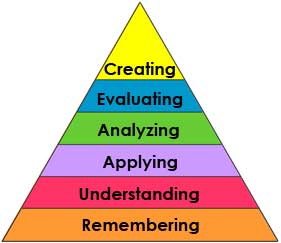
Where does critical thinking fit into the law school graduates’ plans? The lawsuits are disturbing because critical thinking seems to be in short Bloom's Taxonomysupply. No job placement statistics are guarantees. Job placement statistics provide information on the employment of past graduates-not guarantees that current graduates will find jobs. Critical thinking requires, among other things, that people analyze and evaluate information (see the revised Bloom’s taxonomy as pictured in this post) based on reflection, observation, evidence and reasoning. These are, I would hope, hallmarks of legal analysis and are reasonable expectations for those who have up to 7 years of post-secondary education. It’s disheartening to think that law school graduates have not developed those skills as well as I’d like to think.

Or maybe this is evidence that law schools will do anything, even attempt to mislead, in order to make money through recruiting graduates (and future donors).

Twearning: Tweeting and Learning

Student engagement is one of the keys to improving student learning. This semester, students in the sports marketing law class are using twitter to tweet notes during class and to tweet notes while they are reading the textbook or other course-related reading. In addition, students are following the tweets of professional athletes to ultimately identify and discuss legal issues that can arise from the athletes’ use of Twitter. More to come.

Higher ed’s move from pursuit of knowledge to pursuit of enterprise dollars and its impact.

This is a summary of another article that I haven’t yet had time to read-so this information is secondhand. It is interesting because it talks about the University’s move from pursuit of knowledge to pursuit of business dollars.

opendistanceteachingandlearning's avataropendistanceteachingandlearning

[Image retrieved from http://tinyurl.com/786af4q, 31 January 2012]

While this week is a “break” week in the change mooc, I decided to reflect on the article to which I referred last week – Rhoades, R.A. 2011. The U.S. research university as a global model: some fundamentals to consider ( InterActions: UCLA Journal of Education and Information Studies, 7(2): 1-27).

My reason for being intrigued by Rhoads’ (2011) analysis and critique is twofold:

  • Throughout this mooc there were questions asked about the future of higher education and more specifically on how advances in technology are shaping teaching and learning. Rhoads’ analysis indicates that there are other forces at work that we should not lose sight of…
  • I completed my application for “rating” by our National Research Foundation (NRF) as part of the institutional imperative to increase the number of NRF rated researchers resulting in a higher standing for my home…

View original post 934 more words

Painful News About Women & Pain

A recent study about pain attempts to debunk the commonly held belief that women have a higher pain tolerance than men. In a recent blog post, Dan Ariely, reported on a study whose conclusion, based on patients’ self reports, that women rate pain 20% higher than men.

To me, this does not debunk the commonly held belief about women and pain primarily because these are self reports. Women may be more willing to admit pain & less willing to “tough it out.” Second, men may be willing to underreport the amount of pain in order to not seem weak. So I continue to agree with Dr. Ariel’s teacher that women have a higher tolerance for pain.