
Online Learning Trends

In the article Mapping the Terrain of Online Education, Kenneth Green summarizes the increase in online education.  He notes the increase in the number of students taking online courses and ee notes that a significant number of schools require that faculty receive training. He also refers to a Higher Ed article that explains survey results that the significant obstacles to online learning are internal rather than external.

Fresno State is moving in the direction of increasing its offering of online courses. It’s an exciting trend, especially as the focus continues to be on the quality of the courses rather than merely adding online courses just to add them.

The struggle to evaluate the extent and quality of learning in the traditional environment is mirrored in that same struggle in the online environment. How do we know how much/whether students have learned? How do we measure that learning? Which tools work best for which students? Which instructors are more effective using which teaching methods? Where are the benefits of online learning? How are they to be measured? There are a host of questions and some research to answer the questions.  A core question is how do we measure learning in any environment? If we can answer that question, that can help us determine the effectiveness of a variety of teaching methods.
Is Higher Ed Ready to Change?

Credit for this headline goes to Inside Higher Ed, an online newsletter. In the article Is Higher Ed Ready to Change? Doug Lederman, the article author, summarizes commentaries at several meetings of higher ed officials and notes that, although there are some institutions who have adopted changes, there are still many who are reluctant or slow to change.

The article lists a variety of reasons for the slowness. I’ve mentioned the reluctance to change in a previous posting. We are educators: informed, intelligent, engaged and articulate. Yet, as a group, we resist change just as many people do. Change in higher ed seems to occur at a snail’s pace. I think it is because, in part, we (faculty) prefer to analyze prior to taking action and because each faculty member must conduct that analysis independently, the cumulative effect is that little change occurs quickly.

I think of myself as embracing change, as embracing disruptive, transformational change especially, but I know that I also don’t want to embrace a change which harms my students or my discipline and its knowledge.  I also realize that although I embrace change, I still do many things the same way, the way in which I feel most comfortable. Thus, for example, although I can include audio in my blog, I still tend to post written comments and fail to include pictures. Yet the audio and/or pictures could add a richness that may not be apparent from merely writing.

I embrace change, at least, I think I do…….(to be continued…..)

Accessibility and the Law

One challenge in creating online programs is making certain that the courses are accessible. According to the Chronicle article ADA Compliance is a “Major Vulnerability” for Online Programs, many institutions have not established institution-wide policies for ensuring that online courses are accessible.

A corollary challenge is in the use of innovative technologies in the classrooms. As noted in the above-mentioned article, Arizona State was successfully challenged for using Kindles because they are not accessible to the visually impaired.

Universal Design for Learning principles can be used to address some (but not all) of those issues. Just as creating lab partnerships among students can help address some accessibility issues, creating study partnerships can help to make learning more accessible. This is because partners can divide work based on their abilities and no one has to be singled out.

In the lab partnership, the two students can decide between themselves who will conduct the experiment (and that might include opening caps, pouring, reporting visual results) and who will report the results of the experiment. If both students conduct the experiment together, both can benefit.

In the study partnership, if Kindles are to be used, it’s possible that the Kindles and laptops could be employed in the classroom, and students could choose which one they wanted to use.  Then the decision could be based on personal preference, as long as the material was identical.

With other innovations, universal design adaptations may be more difficult. I piloted the use of Second Life, a 3D virtual world, in several classes a couple of years ago. All work had to be done in groups of 2 or 3, so students could choose who would actually go onto Second Life and who would write the reports on the legal issues. Although that was not a “perfect” solution, it worked during the pilot.

As much as possible, though, deliberate, institution-wide strategies that employ Universal Design for Learning Principles can help aid making all courses (online and face to face) accessible.

To Tweet or Not to Tweet

Ok, so Shakespeare might not have tweeted, but it has a nice ring to it.

Students who tweeted earned higher grades than students who did not in a particular class? It sounds like heresey, except that when you read this article in the Journal of Computer Assisted Learning which summarizes an experimental study on use of Twitter in the classroom you see that the instructor used Twitter as a means to facilitate communication about classwork and class requirements. Twitter served as a non-LMS based system for communicating annoucements. Those results are consistent with the idea that those who participate more and access course materials more regularly will be more successful.

The study’s author conducted the end of course survey using NSSE’s student engagement survey and analyzed student active engagement based on Chickering and Gamsons 7 Principles of Good Practice in Undergraduate Education. Interesting use of social media to inform and engage students.

Changing Faculty Roles

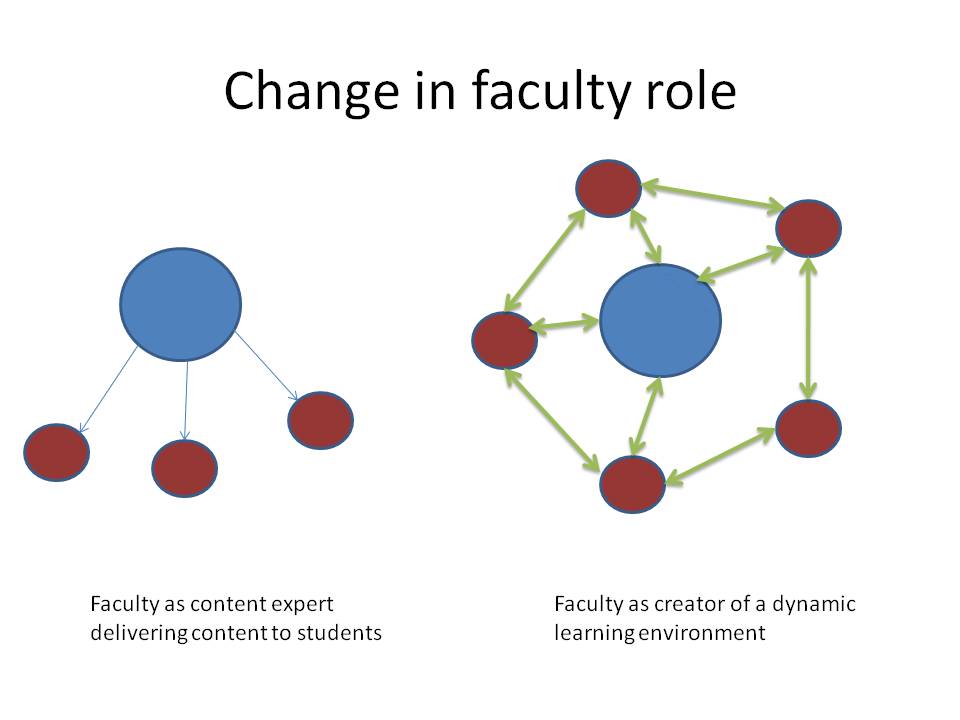
Changing faculty roles: change makes us nervous. How do we, as faculty, recognize and embrace changing roles? The change in roles is due, in part, to the availability of a massive amount of information. This information, available online, makes being a  content expert more nebulous. After all, if I speak of current events, and I allow students to use their laptops or phones in the classroom, they could verify what I say through researching a variety of sources (credible and non-credible).

So, the following is my suggestion for re-viewing our role as faculty. It’s a graphic insight for me–but is one that others have probably already thought about. Thanks, George, for your post about changing faculty roles on the Red Balloon Project.

Any thoughts about this diagram?  Changing faculty roles

Teaching Backwards

I’m attending the Educause conference in Anaheim and listening to Gershenfield who taught a class called “How to Make (Almost) Anything” in which he asked students to come to class a build something. Student started the class with varying amounts of technical skill. He said the best time to get someone to “teach” something is when they first learn it. So, students who learned something that others’ needed to know would teach it over and over again, excitedly, because they were excited about what they had learned. At the end of the course, students had built projects.

What’s interesting about the conversation is the students learned as they needed-they didn’t start with a foundation of knowledge. Yet, they learned what they needed, and he used that methodology in places throughout the world. He asked the question whether MIT was obsolete. His answer: Not yet. Is that a question we should ask in education? And what can we do about it?

More information: Article How to Make (Almost) Anything (http://www.boston.com/news/globe/ideas/articles/2005/01/30/how_to_make_almost_anything/)

Sample class with the Fab Lab (http://fab.cba.mit.edu/classes/MIT/863.08/)

Learning (and Teaching) in the 21st Century

I belong to a reading group on campus that is reading Christopher Hedge’s Empire of Illusion (http://www.amazon.com/Empire-Illusion-Literacy-Triumph-Spectacle/dp/1568584377).

Thursday’s discussion focused in part on the differences in learning abilities now and what constitutes literacy. We discussed the public’s attendance at the Lincoln-Douglas debates to demonstrate the public’s literacy in the mid 1860s. That compared unfavorably with the nature and intellectual challenge of current political debates.  One participant in the discussion noted that the Lincoln-Douglas debates are difficult to read and understand now and this participant considers himself well-educated.

That analysis was interesting. My only comment was to wonder what percentage of people actually attended the debates and we didn’t have the answer. However, on reflection, I have another theory about it. What if the reason the debates were well attended was because that was the way most information was communicated? What if so much information was communicated orally that people who were literate were those who learned best by listening and analysis. If you consider Socrates’ oral tradition and his methods of challenging students to complicated verbal exchanges, it would make sense that those who learned best would be those who learn from listening.

To continue with that thought, what if in the 20th century, those who learn best are those who learn through reading? Those who became professors learned much through poring through books, making connections from that reading and flourished in that system. The oral lectures supplemented that learning, but perhaps we learn best from reading.

Now, we are teaching a generation of students who seem to focus best on “sound bytes” and quick flashes of visual information. Video games manage to attract individuals’ attention to “learn” how to master a game. And many individuals are motivated to follow through on video games enough to analyze a complicated game and develop a strategy to accomplish the goal.

So what does that mean for educators? As educators do we need to change how we change? How do we do that?  How do we get learners to maintain their curiosity about how life works? How to we get learners to develop that curiosity into a curiosity about multiple topics? How do we get learners to become as curious about learning as (many) are about videogames, social media sites and celebrities? That is our challenge.

Innovation in Education….Maybe

The fall semester has begun in earnest and I am teaching 3 different classes plus working with TILT, our faculty development center that focuses on the technology side. I am, in essence, wearing 2 hats-a faculty hat and a quasi-administrative cap.

One of the more frustrating aspects of wearing quasi-administrative gear is the inertia present in large organizations. As I assist with various initiatives, I see where faculty and administrators can sometimes become entrenched in their particular viewpoints. It is apparent that change is not easy. And it is also apparent that it is easier to complain than to work on solving problems.

So why is it that intelligent people (faculty, staff and administrators) have a difficult time accepting change? Is it that all of us are selfish? Is it that when I take what I think is a learner-focused view that I am acting selfishly? Is that selfishness based on my need to feel that I am helping to accomplish a goal? And thus, am I so selfish that I cannot see that there are other legitimate viewpoints that can be equally compelling?

I struggle with the idea that because we’ve always done something a certain way that it must continue to be done in that way. I also struggle with the idea that if there’s something wrong, we should merely fiddle with the something wrong instead of doing something more innovative. Maybe I’m convinced, right or wrong, that our learning environment needs major change and something is better than nothing. Or maybe I just engage in action just to move even though it doesn’t accomplish anything. More later……

Course Redesign

According to a National Center for Course Redesign report, many schools have had success with redesigning math courses using math labs–success as measured by increased completion rates for math classes and cost savings.  (The Course of Innovation: Using Technology to Transform Higher Education) Yet few schools have taken that success and used it to transform other courses within their institutions. Why is that? Why haven’t educators/administrators adopted innovative, technology based models for other courses? Is it the initial cost? Is it lack of knowledge? Is it reluctance to innovate? Aversion to change?