Copyright Law + Education = Strange Bedfellows

In the article, Do Students Have Copyright to their Own Notes, Erica Perez summarizes the arguments pro and con for students owning their class notes. The specific concern was that students were uploading the notes onto websites and, in some cases, purporting to sell them.

First, should students have a copyright in their own notes?  Absolutely!

Students’ notes are copyrighted by the students and students should be able to do anything they want with them, including sell them (although California law makes that illegal) or post them on a website. After all, when students take notes, they’re adding their interpretations of what their instructors present in classes. This is true whether the students copy from a faculty-member provided outline or whether students create and outline the notes solely from lectures or other presentations. And notes memorialize what students heard, so they can use them to study, to study with others in the class and to help students who did not attend class.

So, why the fuss? Faculty believe that the notes students take during class are based on instructors’ intellectual property. That intellectual property is the faculty members’ in-class presentation of research (sometimes) or other information  that the faculty members have developed over time and often at great effort and expense. But let’s examine that point more closely.  Most faculty giants feetdid not create this knowledge independently–they created it by “standing on the shoulders of giants” in their fields and building on those giants’ research and knowledge. Although the instructors present their “take” on the knowledge and the faculty’s presentation is thus copyrightable/copyrighted and valuable, that doesn’t mean that the students cannot copyright their “take” on the information. Each individual’s interpretation of the information has value-and copyright law permits that value to be protected.
This raises a larger issue, though, the issue of “knowledge” in general and the copyright law in particular. In education, we remain wedded to the notion that knowledge resides solely within the purview of the instructor. Think about it, though. According to Google, there are nearly 130 million books (and it plans to digitize all of them). As of August 2010, Google has digitized approximately 12 million.  That does not include other works, such as peer-reviewed articles available in paper and electronic format. It’s impossible for any one faculty member to have mastery over any significant part of that. In fact, that’s the reason that teaching information and digital literacy is so important-it’s not only having some knowledge that’s important, it’s equally important to be able to find and critically evaluation the information that’s available everywhere.

Most of us in higher education teach behind closed doors. We enter the classroom and the teaching and leaRuins of Lamanai-doorrning that occurs behind that door is a secret between the teacher and the students in that course. When students finish that course, they are to emerge with greater knowledge than when they entered. And I hope that’s true. Appropriate assessment can help faculty determine whether that has occurred.

Yet access to information has changed and so, too, must faculty’s role. The recitation and Socratic method of questioning so popular during Socrates’ time was based on the idea that Socrates had “read all the books” and as he presented his oratory he questioned his students to ensure that they were “getting it,” partly because the students hadn’t “read all the books.” Now, students have access to the books and access to a wide variety of digital resources-credible and non-credible. As technology continues to improve, students will be able to use their cell phones to access far more resources than the faculty. Faculty’s role must change to one of assisting students evaluate and manage that information, in addition to passing on the key concepts of a discipline. This evolution involves disruptive, transformational change in the way faculty promote and assess learning.

And copyright law has its own problems in that it, as Lessig would say, stifles creativity. I agree. If we continue to restrict access to

information, that will, of necessity encourage underground versions of information or stifle creative versions of information.

So, should students own the copyright to their notes? Absolutely! Does that have an impact on education? Yes, as long as we continue to teach from behind closed doors.  Should it have that significant an impact? Absolutely not! Let’s move past this discussion to work on institutional change in the way we teach.

Using Research on Learning to Guide Teaching: Huh?!

It seems perfectly sensible and logical. As educators, we should take advantage of the research on how people learn and use it to guide our teaching. But we don’t! Instead, we stick with the tried and true (I did it this way, I learned this way and if students don’t get it, that’s their problem!) I’ve discussed this issue in other posts, for example, Is Higher Education Ready to Change, but it’s worth repeating.

Harvard recently held a one day symposium on the issue to try to encourage faculty to incorporate cognitive research findings into their teaching. This conference kicked off Harvard’s receipt of a $40-million dollar gift. The gift forms the basis of grants to faculty for Harvard’s Initiative on Learning and Teaching.

In a Chronicle article, Harvard Seeks to Jolt University Teaching, Dan Barrett summarizes explanations of the purposes for the symposium and workshop. Barrett quotes Dr. Weiman, a Nobel prize winning physicist, who has conducted research on science education and how students learn, and who explained that faculty often teach by “habits and hunches.” This is partially because most faculty are content experts and not pedagogy experts.

Other conference speakers noted that students are changing, and that, for example, students are not as curious as before.  Dr. Mahzarin R. Banaj debunked the popular belief that teaching should be designed to fit diverse learning styles-e.g. kinesthetic or visual styles. Others noted the importance of quizzing and frequent writing.

So what dDivingoes this mean? It means that Universities should encourage faculty to develop evidence-based teaching practices. It means that faculty workloads would have to be adjusted to permit time for faculty to implement and evaluate new methods of teaching. It means that Universities should assist faculty to assess the impact of these new methods of teaching. The University of Central Florida has a center devoted to helping faculty assess the impact of their teaching.  I’m ready to try it!

MOOC

I love acronyms and this posts starts with a new one for me? MOOC is Massive Open Online Course.  I’m interested in finding out about this different way of teaching and presenting course content. It’s a little bit overwhelming, because it is not “structured” the

Scuba Diving Clipart
scuba diver

way I structure a class. For example, I’m entering during week 6-so there are previous weeks’ work that I haven’t looked at or completed. That is disconcerting for someone my friends characterize as somewhat structured and a workaholic.

So this post is the first of many I may post about MOOC and how/whether I’ve learned, The topic of this course is online learning (in a very broad sense) and this week’s topic is about OER-Open Educational Resources. So, I’m diving in….

Innovation in Academia

One of the pleasant benefits of my current position-working with faculty using technology-is Wordle combination of multiple disciplinary names, e.g. law, art, English, etc.that I have the opportunity to meet faculty from many academic disciplines and to discuss what they teach and how they teach it. It reinvigorates me and I learn different approaches to teaching my own subject. In addition, through this work I met a group of faculty who have worked together to write a manuscript on using videos to engage students and encourage critical thinking. The manuscript is under revision now.

I have frequently lamented universities’ lack of substantive support for cross-disciplinary collaboration and teaching. Perhaps that is because my area of expertise is legal studies-and legal studies are multi-discipinary. So, it was with interest that I read the article Communicating Across the Academic Divide in a January 2, 2011 commentary in the Chronicle of Higher Education. In that post, the author discussed one critical issue that is a barrier to such cross-disciplinary collaboration: inability to easily communicate. The author stated, “Talking across disciplines is as difficult as talking to someone from another culture. Differences in language are the least of the problems; translations may be tedious and not entirely accurate, but they are relatively easy to accomplish. What is much more difficult is coming to understand and accept the way colleagues from different disciplines think—their assumptions and their methods of discerning, evaluating, and reporting “truth”—their disciplinary cultures and habits of mind.”

Interesting and provocative. I had always thought that significant innovation could occur through cross-disciplinary conversations  and had been frustrated by the lack of consistent, sustainable University encouragement of such efforts. But the author’s point is well taken.

While writing the article on using videos, it was evident that we each had different habits of mind and approaches to what would be required for the article. We reachdance or fight shadow imagesed a rough compromise and I hope that that compromise will result in a published article (the first submission was rejected), but my experience confirmed what this author learned: the challenge may be in convincing our colleagues that each of our approaches is genuinely valuable. My experience in coordinating and co-writing the article was positive, yet there were differences in approaches that had to be resolved. And we each had an interest in engaging students and encouraging critical thinking, so our different approaches did not prevent us from reaching a mutually beneficial compromise.

Disruptive, Transformational Change

In the Chronicle article College Grad Rates Stay Exactly the Same, Kevin Carey concludes: “Most of the growth in higher education has come from older, first-generation, immigrant, and lower-income students. It’s easy enough for skeptics to assert that these students aren’t graduating because they’re not college material. I think this massively discounts the likelihood that institutions whose basic structures and cultures were established decades or even centuries ago, for a particular kind of student, have done a poor job of adapting to the needs of different students going to college in a different time.”

It is a significant challenge for those of us who learned and now teach in educational institutions to restructure education to improve learning for all. I have talked in earlier posts about embracing disruptive, transformational change in teaching and learning. Efforts such as the Red Balloon project, spearheaded by George Mehaffy, Vice President of AACSU, grant programs such as the NextGen learning program and others attempt to initiate discussion and action designed to improve education and access to education for all who are interested.

I’m action oriented, though, so although discussion is a necessary precursor, I really just want to try approaches. And that’s where it can be difficult-where are the resources to create an assessment scheme, pilot new approaches, and determine their effectiveness in the short and long term? If I/we/our institution had the resources, I’d encourage others and myself to jump in and try new approaches. I know I’d probably stub my toes, run into walls, trample on some things that work well and muddle through a great deal, but would hope that in that process I’d have some success with encouraging more learning and improved access to education.

That’s the gist of efforts to improve graduation rates. Regardless of how those rates are measured, it is clear that the rates can be improved. And that improvement should involve all students who are interested in a college education, not only those who have traditionally had success in the current education system.

Information Overload and Innovation

In the article Information Overload, Then and Now,  Ann Blair explains that complaints of information overload began two thousand years ago, when people began preserving information through writing . She explains the joy and frustrations created in earlier times in this way: “Writing on durable surfaces (like parchment or paper), with a high level of redundancy (when multiple copies were produced, whether manuscript or printed), also made it possible to recover texts after they had fallen into oblivion, so that being in continuous active use was no longer essential to a text’s transmission, as is the case in an oral culture.”

Information overload in older times included the complication of searching for and finding relevant information. Blair notes the range of history from note-taking, informally collecting information through note-taking and formally storing information alphabetically and using indexing, organization methods within books to make the information more accessible and use of bibliographies. The article ends with a caution to build on what we’ve learned about storing and collecting information as we continue to store, collect and access information in electronic formats.

The issues raised in the article are magnified now that individuals can search using search engines such as Google, can store that information on their own and other computers, can add to that information through online mechanisms such as wikipedia and can create mashups that take data (regardless of its format) and manipulate it quickly to create new materials.

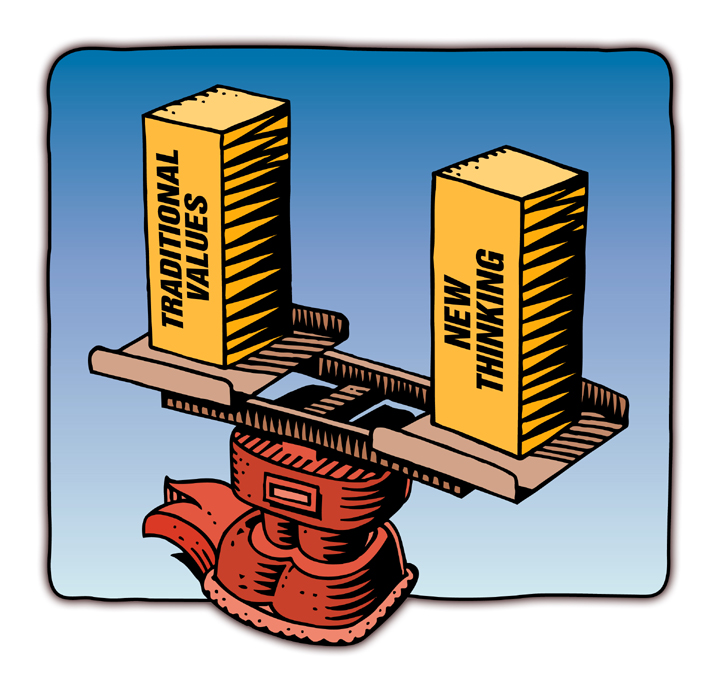
scales balancing traditional values and new thinkingAs we adopt methods to implement disruptive transformational change in teaching and learning, we must remain mindful of the tension between the traditions of knowledge that have served us well and the need to help learners filter through massive amounts of information available at their fingertips. In teaching, that involves, in part, helping students manage information literacy, or the ability to review information to determine its credibility. At the same time, change often occurs through innovation and mashups and using other web 2.0 tools can help create that change. Educators continue to struggle to figure out the best way to accomplish that balance.

Is Higher Ed Ready to Change?

Credit for this headline goes to Inside Higher Ed, an online newsletter. In the article Is Higher Ed Ready to Change? Doug Lederman, the article author, summarizes commentaries at several meetings of higher ed officials and notes that, although there are some institutions who have adopted changes, there are still many who are reluctant or slow to change.

The article lists a variety of reasons for the slowness. I’ve mentioned the reluctance to change in a previous posting. We are educators: informed, intelligent, engaged and articulate. Yet, as a group, we resist change just as many people do. Change in higher ed seems to occur at a snail’s pace. I think it is because, in part, we (faculty) prefer to analyze prior to taking action and because each faculty member must conduct that analysis independently, the cumulative effect is that little change occurs quickly.

I think of myself as embracing change, as embracing disruptive, transformational change especially, but I know that I also don’t want to embrace a change which harms my students or my discipline and its knowledge.  I also realize that although I embrace change, I still do many things the same way, the way in which I feel most comfortable. Thus, for example, although I can include audio in my blog, I still tend to post written comments and fail to include pictures. Yet the audio and/or pictures could add a richness that may not be apparent from merely writing.

I embrace change, at least, I think I do…….(to be continued…..)

Changing Faculty Roles

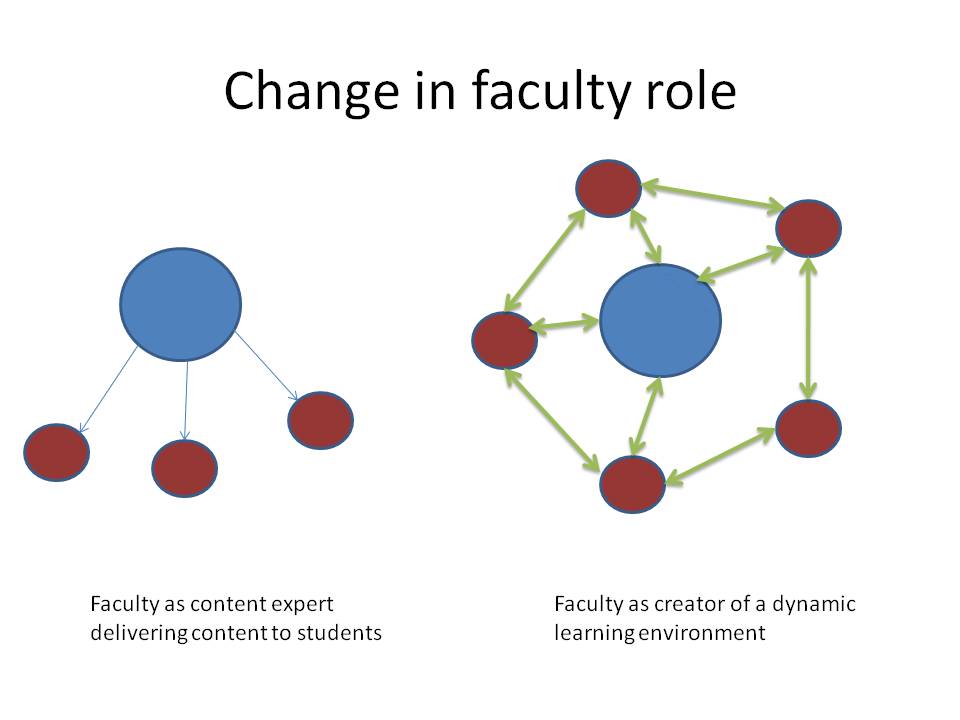
Changing faculty roles: change makes us nervous. How do we, as faculty, recognize and embrace changing roles? The change in roles is due, in part, to the availability of a massive amount of information. This information, available online, makes being a  content expert more nebulous. After all, if I speak of current events, and I allow students to use their laptops or phones in the classroom, they could verify what I say through researching a variety of sources (credible and non-credible).

So, the following is my suggestion for re-viewing our role as faculty. It’s a graphic insight for me–but is one that others have probably already thought about. Thanks, George, for your post about changing faculty roles on the Red Balloon Project.

Any thoughts about this diagram?  Changing faculty roles

Innovation in Education….Maybe

The fall semester has begun in earnest and I am teaching 3 different classes plus working with TILT, our faculty development center that focuses on the technology side. I am, in essence, wearing 2 hats-a faculty hat and a quasi-administrative cap.

One of the more frustrating aspects of wearing quasi-administrative gear is the inertia present in large organizations. As I assist with various initiatives, I see where faculty and administrators can sometimes become entrenched in their particular viewpoints. It is apparent that change is not easy. And it is also apparent that it is easier to complain than to work on solving problems.

So why is it that intelligent people (faculty, staff and administrators) have a difficult time accepting change? Is it that all of us are selfish? Is it that when I take what I think is a learner-focused view that I am acting selfishly? Is that selfishness based on my need to feel that I am helping to accomplish a goal? And thus, am I so selfish that I cannot see that there are other legitimate viewpoints that can be equally compelling?

I struggle with the idea that because we’ve always done something a certain way that it must continue to be done in that way. I also struggle with the idea that if there’s something wrong, we should merely fiddle with the something wrong instead of doing something more innovative. Maybe I’m convinced, right or wrong, that our learning environment needs major change and something is better than nothing. Or maybe I just engage in action just to move even though it doesn’t accomplish anything. More later……

Building University Initiatives

autumn-colors-redChange seems to be an issue for many people.

I must admit that I feel trepidation whenever I have to/need to/want to make a change or do something differently. Yet I tend to embrace the change if it is something that I think will help me do my job better. That’s especially so because teaching and improving learning is somewhat imprecise and isn’t represented by a tangible object that can be easily measured.

It’s interesting to watch others’ response to proposed change. The variations in response always surprise me, even though by now I should expect it. Although I think of educators as thinkers and innovators, not all are. Many are content to do what they’ve always done, just as others in non-education fields can be content.

A colleague once told me that when we redesign courses, we should not only look at those courses where the failure rate is high. We should also examine the courses (especially when they are the same courses) where the pass rate is extremely high. The issue might be that the standards in the course where the pass rate is extremely high either have answers that can be passed along or that that particular  instructor is not holding students to high standards.