Reinventing the Wheel in Academia

image wooden wheelWhy is it that in academia we do not routinely adopt “best practices” created by other institutions? Why is it that we prefer to reinvent the wheel?

Maybe it’s the fact that to earn a doctorate one had to research and write an innovative, new, previously un-researched aspect of one’s discipline. The mindset that permits one to succeed in that environment may also be a mindset that prevents one from merely adopting another’s practices. Maybe it’s also the fact that each institution believes that its students and environment are so unique that what works for one institution will not necessarily work for another.

It is the latter belief in each institution’s uniqueness, that is the topic discussed in Beating the ‘Not Invented Here’ article by Josh Fischman in the Chronicle’s Wired Campus. In the article, the author summarizes a panel presentation by stating “There are plenty of good ideas, the two said, but colleges are reluctant to adopt solutions that did not arise from their own campuses.”

One example of that on our campus is student evaluations. At the end of each semester, students complete evaluation forms for every course taught by adjunct and tenure track faculty. Each college in the University has a different evaluation form and many of the forms were developed by a group of faculty within each school. There are commercial instruments available composed of validated, reliable questions-yet faculty choose not to use them because, in part, our campus is so unique.

Student course evaluations can have an inordinate impact on faculty retention and promotion. This is true whether the course evaluations are composed of rigorously tested questions or not. And, this is true even though students may not be entirely honest about their answers to the questions. In my post Another A Word-Course Evaluations, I talk about a study in which one of its findings was that students lie in course evaluations. Even though that is probably true, and it is also true that faculty can (and may have an incentive to) manipulate course evaluations, faculty committees and administrators continue to place inordinate weight on those evaluations when making hiring, promotion and tenure decisions. The point here is that if course evaluations are to be used to make such decisions, those evaluations should be based on reliable, validated questions created by experts.

The point of the example is that universities should embrace best practices that haveimage sports wheel been successful and universities should focus upgrading the wheel rather than reinventing it. That would be more efficient, more effective and permit faculty to focus on improving teaching and learning.

Innovation in Academia

One of the pleasant benefits of my current position-working with faculty using technology-is Wordle combination of multiple disciplinary names, e.g. law, art, English, etc.that I have the opportunity to meet faculty from many academic disciplines and to discuss what they teach and how they teach it. It reinvigorates me and I learn different approaches to teaching my own subject. In addition, through this work I met a group of faculty who have worked together to write a manuscript on using videos to engage students and encourage critical thinking. The manuscript is under revision now.

I have frequently lamented universities’ lack of substantive support for cross-disciplinary collaboration and teaching. Perhaps that is because my area of expertise is legal studies-and legal studies are multi-discipinary. So, it was with interest that I read the article Communicating Across the Academic Divide in a January 2, 2011 commentary in the Chronicle of Higher Education. In that post, the author discussed one critical issue that is a barrier to such cross-disciplinary collaboration: inability to easily communicate. The author stated, “Talking across disciplines is as difficult as talking to someone from another culture. Differences in language are the least of the problems; translations may be tedious and not entirely accurate, but they are relatively easy to accomplish. What is much more difficult is coming to understand and accept the way colleagues from different disciplines think—their assumptions and their methods of discerning, evaluating, and reporting “truth”—their disciplinary cultures and habits of mind.”

Interesting and provocative. I had always thought that significant innovation could occur through cross-disciplinary conversations  and had been frustrated by the lack of consistent, sustainable University encouragement of such efforts. But the author’s point is well taken.

While writing the article on using videos, it was evident that we each had different habits of mind and approaches to what would be required for the article. We reachdance or fight shadow imagesed a rough compromise and I hope that that compromise will result in a published article (the first submission was rejected), but my experience confirmed what this author learned: the challenge may be in convincing our colleagues that each of our approaches is genuinely valuable. My experience in coordinating and co-writing the article was positive, yet there were differences in approaches that had to be resolved. And we each had an interest in engaging students and encouraging critical thinking, so our different approaches did not prevent us from reaching a mutually beneficial compromise.

Downsides of Curricular Innovation

Escape buttonDoes innovation mean dumbing down?

The National Center for Academic Transformation (NCAT) urges institutions to develop low cost, effective methods to deliver course content and improve learning. Efficient uses of technology are integral to that process.

But what if the technology is a substitute for professors? That is one of the greatest fears of academics-that faculty will be replaced with professors in a box who do not “teach” and that instead serve as reviewers similar to instructors in correspondence courses.

In the article A Curricular Innovation, Reexamined, an Inside Higher Education special report on a for-credit set of courses organized by StraighterLine, the organization raised questions about the use of technology in teaching. According to the article, the courses are cheap (unlimited for $99 per month, $399/course, or 10 for $999) and are accepted for credit at some institutions. The report highlighted some positives-individual tutoring and the ability to self-test for improvement and some negatives–older course materials and significant numbers of errors.

I think that quality can be incorporated into online courses. The report reminds me 50s Robotthat we need to be vigilant to be sure that online materials must be checked for rigor. The report also reminds me that face-to-face courses are seldom rigorously evaluated and should be subject to the similar oversight for quality.

Have you ever presented materials (PowerPoint slides, handouts, exams), that had errors? Have you ever said something in class that was wrong and later had to correct it? In a face-to-face class, the only people who know you made those errors are the students who saw the materials. Seldom do our peers review all our materials and note errors. In an online class, those items are memoralized electronically in the course and thus errors can be more easily identified. Since many faculty want to check online course materials more carefully, the errors become a basis for arguing that online education and materials are inferior.

So what does that mean for innovation? We must innovate and as faculty we should be integrally involved in oversight of face to face and online courses. We have to figure out the balance between academic freedom and evaluating quality, but some of the problems discovered in online courses are also equally evident upon review of face to face courses.

Let’s treat both with equal rigor.

Accessibility and Innovation

In the article Colleges Lock Out Blind Students Online, Marc Parry describes the one-man odyssey of Darrell Shandrow, a self-described blind journalism student who has embarked on a campaign to demand that universities across the United States incorporate acccessibility into their design of websites, textbooks and all other college experiences. Mr. Shandrow joined the lawsuit filed by the National Federal for the Blind against Arizona State University for its use of Kindle eReaders for etextbooks. According to Parry, Kindle eReaders’ menus are not accessible, although the Kindle does include text to speech software.

In a previous post, I talked about Universal Design for Learning and some of the legal requirements for accessibility. As I noted in that post, one of the key tenants of UDL is that instructional materials should incorporate as many approaches as possible so that many different learners can understand the material. That approach makes sense from a philosophical point of view. However, practically speaking, it is difficult to develop a non time-intensive way for faculty to implement it. I am part of a Faculty Learning Community Teachers in different posesat Fresno State that is working on helping faculty implement those principles in teaching. We are a group of approximately 20 faculty who are using the book Universal Design in Higher Education by Burgstahler and Cory to prepare instruction and/or materials that incorporate UDL principles. I have learned a great deal from that experience and look forward to the opportunity to incorporate UDL into my courses.
Parry’s article highlights a tension that exists between accessibility and innovation. Creating Magnetmaterials and delivering instruction using UDL principles automatically results in increasing the amount of content that is accessible on many dimensions.  However, it takes time and it can sometimes stifle innovation when that approach is adopted for all new things. I wholeheartedly agree with UDL and accessibility principles, yet as someone who likes to push the envelope, I sometimes find that that approach creates barriers to immediately trying a new approach. Conducting pilots help to provide balance but that can create obstacles to more comprehensive implementation.

Sometimes, I just want to dive in when I find something new. That new thing could be a new technology, a new teaching approach, implementation of information from an article about a new theory with which I was not familiar or just something different. I dive in and sometimes I learn what others already knew, but which, for some reason, I needed to learn for myself. I dive in and sometimes IDiving in a no diving area learn something new that I can use and that others also find useful. When I incorporate UDL and accessibility as a habit of mind, though, I must exercise more caution and that can sometimes stifle creativity. So, although I strongly support UDL principles and support implementation of them in my classes, I realize that I must also more carefully consider the options before jumping in. Thus the implementation of UDL has a cost of reducing innovation. Maybe that’s a cost that’s an acceptable one in light of the benefits of UDL.  That’s something to consider.

Information Overload and Innovation

In the article Information Overload, Then and Now,  Ann Blair explains that complaints of information overload began two thousand years ago, when people began preserving information through writing . She explains the joy and frustrations created in earlier times in this way: “Writing on durable surfaces (like parchment or paper), with a high level of redundancy (when multiple copies were produced, whether manuscript or printed), also made it possible to recover texts after they had fallen into oblivion, so that being in continuous active use was no longer essential to a text’s transmission, as is the case in an oral culture.”

Information overload in older times included the complication of searching for and finding relevant information. Blair notes the range of history from note-taking, informally collecting information through note-taking and formally storing information alphabetically and using indexing, organization methods within books to make the information more accessible and use of bibliographies. The article ends with a caution to build on what we’ve learned about storing and collecting information as we continue to store, collect and access information in electronic formats.

The issues raised in the article are magnified now that individuals can search using search engines such as Google, can store that information on their own and other computers, can add to that information through online mechanisms such as wikipedia and can create mashups that take data (regardless of its format) and manipulate it quickly to create new materials.

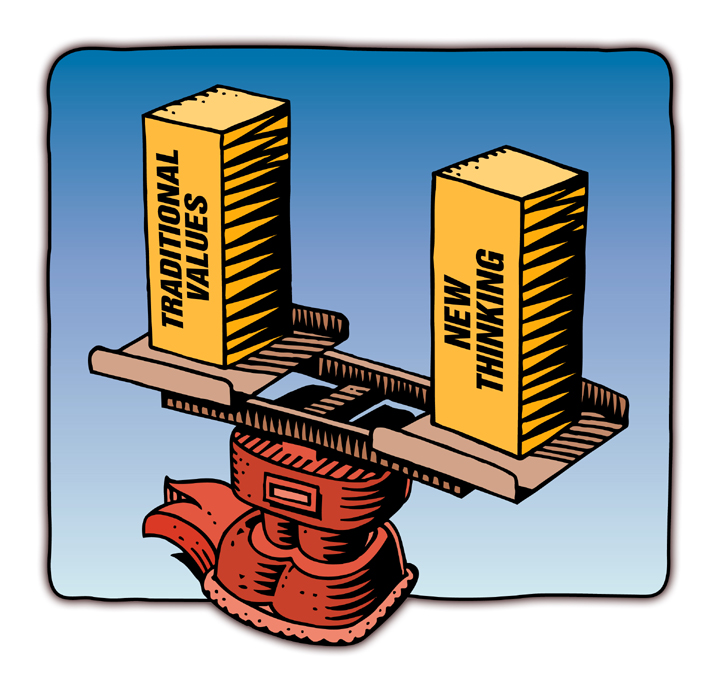
scales balancing traditional values and new thinkingAs we adopt methods to implement disruptive transformational change in teaching and learning, we must remain mindful of the tension between the traditions of knowledge that have served us well and the need to help learners filter through massive amounts of information available at their fingertips. In teaching, that involves, in part, helping students manage information literacy, or the ability to review information to determine its credibility. At the same time, change often occurs through innovation and mashups and using other web 2.0 tools can help create that change. Educators continue to struggle to figure out the best way to accomplish that balance.

Accessibility and the Law

One challenge in creating online programs is making certain that the courses are accessible. According to the Chronicle article ADA Compliance is a “Major Vulnerability” for Online Programs, many institutions have not established institution-wide policies for ensuring that online courses are accessible.

A corollary challenge is in the use of innovative technologies in the classrooms. As noted in the above-mentioned article, Arizona State was successfully challenged for using Kindles because they are not accessible to the visually impaired.

Universal Design for Learning principles can be used to address some (but not all) of those issues. Just as creating lab partnerships among students can help address some accessibility issues, creating study partnerships can help to make learning more accessible. This is because partners can divide work based on their abilities and no one has to be singled out.

In the lab partnership, the two students can decide between themselves who will conduct the experiment (and that might include opening caps, pouring, reporting visual results) and who will report the results of the experiment. If both students conduct the experiment together, both can benefit.

In the study partnership, if Kindles are to be used, it’s possible that the Kindles and laptops could be employed in the classroom, and students could choose which one they wanted to use.  Then the decision could be based on personal preference, as long as the material was identical.

With other innovations, universal design adaptations may be more difficult. I piloted the use of Second Life, a 3D virtual world, in several classes a couple of years ago. All work had to be done in groups of 2 or 3, so students could choose who would actually go onto Second Life and who would write the reports on the legal issues. Although that was not a “perfect” solution, it worked during the pilot.

As much as possible, though, deliberate, institution-wide strategies that employ Universal Design for Learning Principles can help aid making all courses (online and face to face) accessible.

To Tweet or Not to Tweet

Ok, so Shakespeare might not have tweeted, but it has a nice ring to it.

Students who tweeted earned higher grades than students who did not in a particular class? It sounds like heresey, except that when you read this article in the Journal of Computer Assisted Learning which summarizes an experimental study on use of Twitter in the classroom you see that the instructor used Twitter as a means to facilitate communication about classwork and class requirements. Twitter served as a non-LMS based system for communicating annoucements. Those results are consistent with the idea that those who participate more and access course materials more regularly will be more successful.

The study’s author conducted the end of course survey using NSSE’s student engagement survey and analyzed student active engagement based on Chickering and Gamsons 7 Principles of Good Practice in Undergraduate Education. Interesting use of social media to inform and engage students.

Changing Faculty Roles

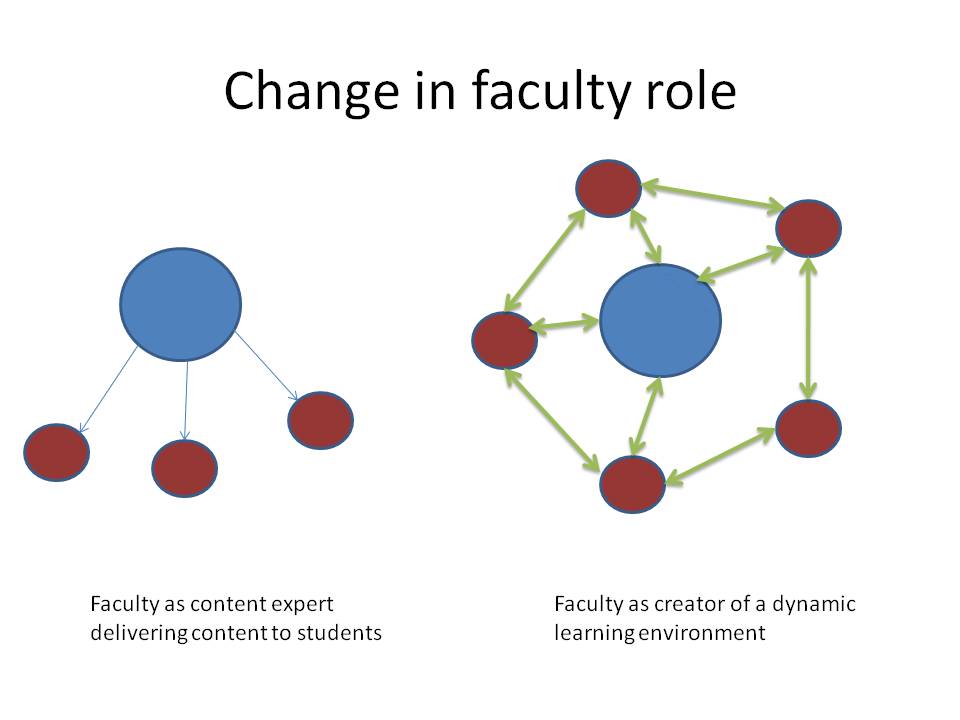
Changing faculty roles: change makes us nervous. How do we, as faculty, recognize and embrace changing roles? The change in roles is due, in part, to the availability of a massive amount of information. This information, available online, makes being a  content expert more nebulous. After all, if I speak of current events, and I allow students to use their laptops or phones in the classroom, they could verify what I say through researching a variety of sources (credible and non-credible).

So, the following is my suggestion for re-viewing our role as faculty. It’s a graphic insight for me–but is one that others have probably already thought about. Thanks, George, for your post about changing faculty roles on the Red Balloon Project.

Any thoughts about this diagram?  Changing faculty roles

Teaching Backwards

I’m attending the Educause conference in Anaheim and listening to Gershenfield who taught a class called “How to Make (Almost) Anything” in which he asked students to come to class a build something. Student started the class with varying amounts of technical skill. He said the best time to get someone to “teach” something is when they first learn it. So, students who learned something that others’ needed to know would teach it over and over again, excitedly, because they were excited about what they had learned. At the end of the course, students had built projects.

What’s interesting about the conversation is the students learned as they needed-they didn’t start with a foundation of knowledge. Yet, they learned what they needed, and he used that methodology in places throughout the world. He asked the question whether MIT was obsolete. His answer: Not yet. Is that a question we should ask in education? And what can we do about it?

More information: Article How to Make (Almost) Anything (http://www.boston.com/news/globe/ideas/articles/2005/01/30/how_to_make_almost_anything/)

Sample class with the Fab Lab (http://fab.cba.mit.edu/classes/MIT/863.08/)