
Great blog post on how to make the point that contracts should be in writing rather than oral.
Useful for making that point when teaching contract law.
Great blog post on how to make the point that contracts should be in writing rather than oral.
Useful for making that point when teaching contract law.
Changing faculty roles: change makes us nervous. How do we, as faculty, recognize and embrace changing roles? The change in roles is due, in part, to the availability of a massive amount of information. This information, available online, makes being a content expert more nebulous. After all, if I speak of current events, and I allow students to use their laptops or phones in the classroom, they could verify what I say through researching a variety of sources (credible and non-credible).
So, the following is my suggestion for re-viewing our role as faculty. It’s a graphic insight for me–but is one that others have probably already thought about. Thanks, George, for your post about changing faculty roles on the Red Balloon Project.
Any thoughts about this diagram? 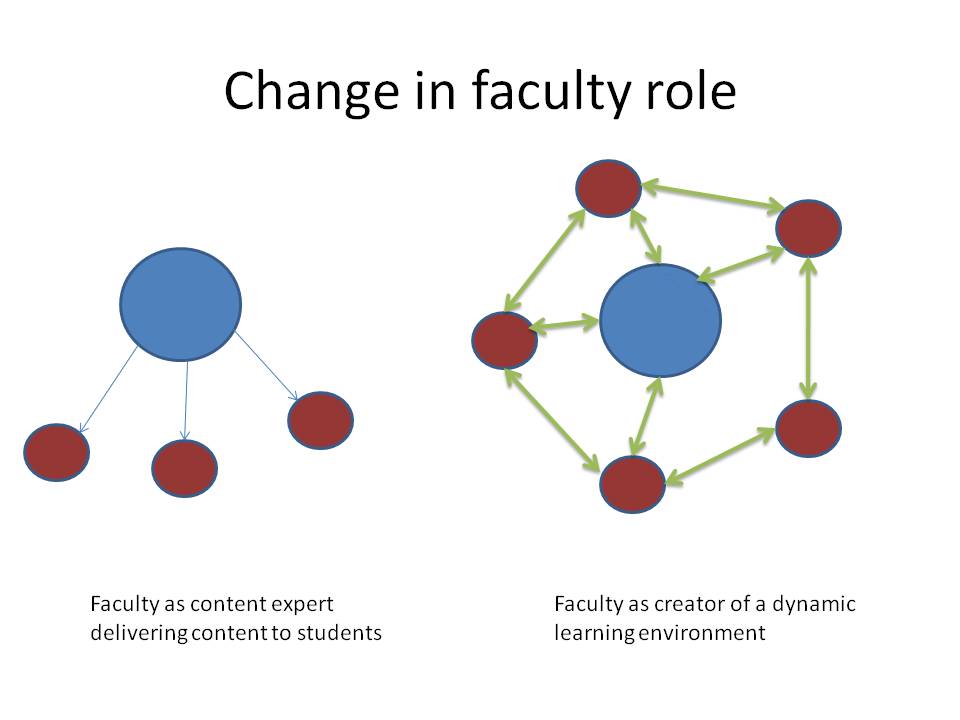
Proctoring exams is the most effective way to prevent cheating on exams, whether the exams are part of a face to face or an online program. This is the conclusion according to the summary of a meta-study on cheating featured in an article, Proctor or Gamble, in today’s issue of Inside Higher Education.
Not surprisingly, the issue can be a more significant issue in online courses that rely solely or primarily on the results of multiple choice exams to determine the grade earned by a student. This study confirms what many who teach online already knew: multiple choice/true-false exams should not be a significant portion of the overall grade for an online course. Those items should be used for self-study and self-tests, but not to determine the course grade. Teaching online requires re-assessing how to assess. Business as usual is not as effective.
I attended the Intellagirl led presentation on the use of games to encourage student learning. You can see my tweets that summarized some of the points. Here’s an article from Inside Higher Ed for it: Gaming as Teaching Tool.
I’m attending the Educause conference in Anaheim and listening to Gershenfield who taught a class called “How to Make (Almost) Anything” in which he asked students to come to class a build something. Student started the class with varying amounts of technical skill. He said the best time to get someone to “teach” something is when they first learn it. So, students who learned something that others’ needed to know would teach it over and over again, excitedly, because they were excited about what they had learned. At the end of the course, students had built projects.
What’s interesting about the conversation is the students learned as they needed-they didn’t start with a foundation of knowledge. Yet, they learned what they needed, and he used that methodology in places throughout the world. He asked the question whether MIT was obsolete. His answer: Not yet. Is that a question we should ask in education? And what can we do about it?
More information: Article How to Make (Almost) Anything (http://www.boston.com/news/globe/ideas/articles/2005/01/30/how_to_make_almost_anything/)
Sample class with the Fab Lab (http://fab.cba.mit.edu/classes/MIT/863.08/)
I belong to a reading group on campus that is reading Christopher Hedge’s Empire of Illusion (http://www.amazon.com/Empire-Illusion-Literacy-Triumph-Spectacle/dp/1568584377).
Thursday’s discussion focused in part on the differences in learning abilities now and what constitutes literacy. We discussed the public’s attendance at the Lincoln-Douglas debates to demonstrate the public’s literacy in the mid 1860s. That compared unfavorably with the nature and intellectual challenge of current political debates. One participant in the discussion noted that the Lincoln-Douglas debates are difficult to read and understand now and this participant considers himself well-educated.
That analysis was interesting. My only comment was to wonder what percentage of people actually attended the debates and we didn’t have the answer. However, on reflection, I have another theory about it. What if the reason the debates were well attended was because that was the way most information was communicated? What if so much information was communicated orally that people who were literate were those who learned best by listening and analysis. If you consider Socrates’ oral tradition and his methods of challenging students to complicated verbal exchanges, it would make sense that those who learned best would be those who learn from listening.
To continue with that thought, what if in the 20th century, those who learn best are those who learn through reading? Those who became professors learned much through poring through books, making connections from that reading and flourished in that system. The oral lectures supplemented that learning, but perhaps we learn best from reading.
Now, we are teaching a generation of students who seem to focus best on “sound bytes” and quick flashes of visual information. Video games manage to attract individuals’ attention to “learn” how to master a game. And many individuals are motivated to follow through on video games enough to analyze a complicated game and develop a strategy to accomplish the goal.
So what does that mean for educators? As educators do we need to change how we change? How do we do that? How do we get learners to maintain their curiosity about how life works? How to we get learners to develop that curiosity into a curiosity about multiple topics? How do we get learners to become as curious about learning as (many) are about videogames, social media sites and celebrities? That is our challenge.
The fall semester has begun in earnest and I am teaching 3 different classes plus working with TILT, our faculty development center that focuses on the technology side. I am, in essence, wearing 2 hats-a faculty hat and a quasi-administrative cap.
One of the more frustrating aspects of wearing quasi-administrative gear is the inertia present in large organizations. As I assist with various initiatives, I see where faculty and administrators can sometimes become entrenched in their particular viewpoints. It is apparent that change is not easy. And it is also apparent that it is easier to complain than to work on solving problems.
So why is it that intelligent people (faculty, staff and administrators) have a difficult time accepting change? Is it that all of us are selfish? Is it that when I take what I think is a learner-focused view that I am acting selfishly? Is that selfishness based on my need to feel that I am helping to accomplish a goal? And thus, am I so selfish that I cannot see that there are other legitimate viewpoints that can be equally compelling?
I struggle with the idea that because we’ve always done something a certain way that it must continue to be done in that way. I also struggle with the idea that if there’s something wrong, we should merely fiddle with the something wrong instead of doing something more innovative. Maybe I’m convinced, right or wrong, that our learning environment needs major change and something is better than nothing. Or maybe I just engage in action just to move even though it doesn’t accomplish anything. More later……
Some faculty have objected to addressing accessibility in their classes if it involves additional work-doing more than they already do. The objections are two major categories: 1. that captioning videos is too expensive and neither the schools nor departments will pay for them and 2. that they will make accommodations if they have disabled students in their classes, otherwise they see no need to do so.
Faculty have a good deal of work to do in order to teach effectively and to promote learning. Many members of the general public think that college faculty only work 12 hours per week (the length of time spent in a face to face classroom). Few realize how much effort goes into creating good lectures, creating learning materials, grading assignments and developing alternate methods to present materials. And faculty who are effective online teachers may spend additional time creating/supplementing materials for the online environment.
So how can faculty incorporate accessibility or Universal Design for Learning (UDL) principles without significant additional work? It depends on what the faculty member does when teaching. Just a couple of tips
Lecturing:
present lecture outlines/notes prior so a student can use those to take notes
describe pictures, models and demos used in class in addition to showing those
Other tips are here: Delivering Accessible Lectures (from a Scottish University…)
 Change seems to be an issue for many people.
I must admit that I feel trepidation whenever I have to/need to/want to make a change or do something differently. Yet I tend to embrace the change if it is something that I think will help me do my job better. That’s especially so because teaching and improving learning is somewhat imprecise and isn’t represented by a tangible object that can be easily measured.
It’s interesting to watch others’ response to proposed change. The variations in response always surprise me, even though by now I should expect it. Although I think of educators as thinkers and innovators, not all are. Many are content to do what they’ve always done, just as others in non-education fields can be content.
A colleague once told me that when we redesign courses, we should not only look at those courses where the failure rate is high. We should also examine the courses (especially when they are the same courses) where the pass rate is extremely high. The issue might be that the standards in the course where the pass rate is extremely high either have answers that can be passed along or that that particular instructor is not holding students to high standards.
Great attendance at the Syllabus Redesign Conference at Fresno State for Day 2.
Explaining student expectations and information literacy information went well.
Explaining issues of accessibility and making a syllabus accessible was more problematic. The video didn’t work until late and there were a number of questions/debates about the meaning of accessibility. We’re definitely going to have to do a better job informing faculty about the tools of accessibility this year. The low-key approach has resulted in a vocal group of faculty who’ve been mostly unaware of what’s being going on behind the scenes for the last 3-4 years (or more) on accessibility.
We have much more to do to provide more information to more faculty so they’re not so afraid of the idea of providing information in as many formats as possible without overwhelmingly increasing their workloads.
 Ida's Blog